ORIGINAL ARTICLE
Two lichen species, Bacidina caerulea and B. flavoleprosa (Ramalinaceae, Ascomycota), new to Poland and notes on the taxonomy of B. flavoleprosa
1
Department of Plant Taxonomy and Nature Conservation, Faculty of
Biology, University of Gdańsk, Wita Stwosza 59, 80-308 Gdańsk,
Poland
Submission date: 2025-06-27
Acceptance date: 2026-03-26
Online publication date: 2026-07-31
Publication date: 2026-07-31
Plant and Fungal Systematics 2026; 71(1): 22-26
KEYWORDS
ABSTRACT
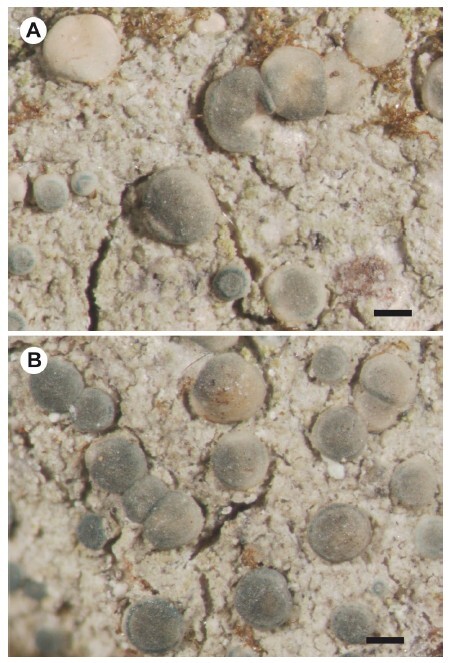
Two species, Bacidina caerulea and B. flavoleprosa, are reported from Poland.
DNA sequencing was performed on all Polish specimens of both species. The nuITS
rDNA sequence of B. caerulea showed 100% similarity to the OP256853 sequence, with
no differences in nucleotide substitutions between them. In the case of B. flavoleprosa,
Polish specimens exhibit a high degree of morphological and anatomical similarity to the
protologue of B. flavoleprosa, however, the number of nucleotide substitutions in nuITS
rDNA sequences referred to as this species shows considerable variation. However, since
the morphology of the Polish specimens agree with that of B. flavoleprosa, and the number
of available sequences is limited, we refrain from describing a new species.
REFERENCES (31)
1.
Altschul, S. F., Gish, W., Miller, W., Myers, E. W. & Lipman, D. J. 1990. Basic local alignment search tool. Journal of Molecular Biology 215: 403–410. https://doi.org/10.1016/S0022-....
2.
Boom, P. P. G. van den & Alvarado, P. 2025. New Species of Bacidia s.l. from the Azores and the Resurrection of Genus Woessia. Diversity 17: 187. https://doi.org/10.3390/d17030....
3.
Cannon, P., Ekman, S., Kistenich, S., LaGreca, S., Printzen, C., Timdal, E., Aproot, A., Coppins, B., Fletcher, A., Sanderson, N. & Simkin, J. 2021. Lecanorales: Ramalinaceae. Revisions of British and Irish Lichens 11: 1–82.
4.
Clement, M., Snell, Q., Walker, P., Posada, D. & Crandall, K. 2002. TCS: Estimating gene genealogies. Proceedings 16th International Parallel and Distributed Processing Symposium, Ft. Lauderdale, FL, USA, p. 184. https://doi.org/10.1109/IPDPS.....
5.
Czarnota, P. & Guzow-Krzemińska, B. 2012. ITS rDNA data confirm a delimitation of Bacidina arnoldiana and B. sulphurella and support a description of a new species within the genus Bacidina. The Lichenologist 44(6): 743–755. https://doi.org/10.1017/S00242....
6.
Czarnota, P. & Guzow-Krzemińska, B. 2018. Bacidina mendax sp. nov., a new widespread species in Central Europe, together with a new combination within the genus Bacidina. The Lichenologist 50(1): 43–57. https://doi.org/10.1017/S00242....
7.
Ekman, S. 1996. The corticolous and lignicolous species of Bacidia and Bacidina in North America. Opera Botanica 127: 1–148.
8.
Ekman, S. 2001. Molecular phylogeny of the Bacidiaceae (Lecanorales, lichenized Ascomycota). Mycological Research 105: 783–797. https://doi.org/10.1017/S09537....
9.
Ekman, S. 2023. Four new and two resurrected species of Bacidina from Sweden, with notes and a preliminary key to the known Scandinavian species. Nordic Journal of Botany 5: e03846. https://doi.org/10.1111/njb.03....
10.
Galtier, N., Gouy, M. & Gautier, C. 1996. Seaview and phylo_win: Two graphic tools for sequence alignment and molecular phylogeny. Bioinformatics 12(6): 543–548. https://doi.org/10.1093/bioinf....
11.
Gerasimova, J. V., Ezhkin, A. K., Davydov, E. A. & Beck, A. 2021. Multilocus-phylogeny of the lichen-forming genus Bacidia s.str. (Ramalinaceae, Lecanorales) with special emphasis on the Russian Far East. The Lichenologist 53: 441–455. https://doi.org/10.1017/S00242....
12.
Gerasimova, J. V., Otte, V., Urbanavichene, I. N., Urbanavichus, G. P. & Beck, A. 2023. High diversity of Bacidia (Ramalinaceae, Lecanorales) species in the Caucasus as revealed by molecular and morphological analyses. The Lichenologist 55(5): 275–296. https://doi.org/10.1017/S00242....
13.
Gouy, M., Guindon, S. & Gascuel, O. 2010. SeaView version 4: A multiplatform graphical user interface for sequence alignment and phylogenetic tree building. Molecular Biology and Evolution 27(2): 221–224. https://doi.org/10.1093/molbev....
14.
Guzow-Krzemińska, B. & Węgrzyn, G. 2000. Potential use of restriction analysis of PCR-amplified DNA fragments in taxonomy of lichens. Mycotaxon 76: 305–313.
15.
Guzow-Krzemińska, B., Jabłońska, A., Flakus, A., Rodriguez-Flakus, P., Kosecka, M. & Kukwa, M. 2019. Phylogenetic placement of Lepraria cryptovouauxii sp. nov. (Lecanorales, Lecanoromycetes, Ascomycota) with notes on other Lepraria species from South America. MycoKeys 53: 1–22. https://doi.org/10.3897/mycoke....
16.
Hall, T. 2011. BioEdit: An important software for molecular biology. GERF Bulletin of Biosciences 2: 60–61.
17.
Hawksworth, D. L. & Poelt, J. 1986. Five additional genera of conidial lichen-forming fungi from Europe. Plant Systematics and Evolution 154: 195–211. https://doi.org/10.1007/BF0099....
18.
Körber, G. W. 1860. Parerga Lichenologica: Ergänzungen zum Systema lichenum Germaniae 2. Eduard Trewendt, Breslau.
19.
Lücking, R. 2008. Foliicolous lichenized fungi. Flora Neotropica Monograph 103: 1–867.
20.
Lücking, R., Wirth, V. & Ahrens, M. 2009. Foliicolous Lichens in the Black Forest, Southwest-Germany. Carolinea 67: 23–31.
21.
Mark, K., Cornejo, C., Keller, C., Flück, D. & Scheidegger, C. 2016. Barcoding lichen-forming fungi using 454 pyrosequencing is challenged by artifactual and biological sequence variation. Genome 59: 685–704. https://doi.org/10.1139/gen-20....
22.
Molenaar, M., van der Kolk, H.-J. & van den Boom, P. 2023. Een overzicht van de boombewonende knoopjeskorsten van Nederland [Corticolous Bacidia and Bacidina species in the Netherlands]. Buxbaumiella 128: 8–23.
23.
Ossowska, E., Guzow-Krzemińska, B., Dudek, M., Oset, M. & Kukwa, M. 2018. Evaluation of diagnostic chemical and morphological characters in five Parmelia species (Parmeliaceae, lichenized Ascomycota) with special emphasis on the thallus pruinosity. Phytotaxa 383(2): 165–180. https://doi.org/10.11646/phyto....
24.
Ossowska, E., Guzow-Krzemińska, B., Kolanowska, M., Szczepańska, K. & Kukwa, M. 2019. Morphology and secondary chemistry in species recognition of Parmelia omphalodes group – Evidence from molecular data with notes on the ecological niche modelling and genetic variability of photobionts. MycoKeys 61: 39–74. https://doi.org/10.3897/mycoke....
25.
Ossowska, E. A., Schiefelbein, U., Szymczyk, R. & Kukwa, M. 2023. Contribution to the knowledge of the distribution of Parmelia species (Parmeliaceae, Ascomycota) – New records confirmed by molecular data. Acta Mycologica 58: 1–11. https://doi.org/10.5586/am/175....
26.
Sérusiaux, E. 1995. Further new lichen species producing campylidia or complex conidiomata. Bibliotheca Lichenologica 58: 411–431.
27.
Szczepańska, K., Kukwa, M. & Ossowska, E. A. 2024. Aspicilia fluviatilis and Circinaria leprosescens, two lichen species of the family Megasporaceae new to Poland. Acta Mycologica 59: 1–6. https://doi.org/10.5586/am/192....
28.
Szymczyk, R., Ossowska, E. A., Guzow-Krzemińska, B., Zalewska, A., Kowalewska, A. & Kukwa, M. 2024. New and noteworthy lichen species in Poland. Acta Mycologica 59: 1–9. https://doi.org/10.5586/am/192....
29.
Vĕzda, A. 1983. Foliicole Flechten aus der Kolchis (West-Transkaukasien, UdSSR). Folia Geobotanica & Phytotaxonomica 18: 45–70.
30.
Vĕzda, A. 1991. Bacidina genus novum familiae Lecideaceae (Ascomycetes lichenisati). Folia Geobotanica & Phytotaxonomica 25: 431–432.
31.
Vondrák, J., Svoboda, S., Košnar, J., Malíček, J., Šoun, J., Frolov, I., Svensson, M., Novotný, P. & Palice, Z. 2023. Martin7: a reference database of DNA barcodes for European epiphytic lichens and its taxonomic implications. Preslia 95: 311–345. https://doi.org/10.23855/presl....
Share
RELATED ARTICLE
| eISSN: | 2657-5000 |
| ISSN: | 2544-7459 |


We process personal data collected when visiting the website. The function of obtaining information about users and their behavior is carried out by voluntarily entered information in forms and saving cookies in end devices. Data, including cookies, are used to provide services, improve the user experience and to analyze the traffic in accordance with the Privacy policy. Data are also collected and processed by Google Analytics tool (more).
You can change cookies settings in your browser. Restricted use of cookies in the browser configuration may affect some functionalities of the website.
You can change cookies settings in your browser. Restricted use of cookies in the browser configuration may affect some functionalities of the website.