ORIGINAL ARTICLE
Notes on the Ramalina pollinaria group (Ramalinaceae, Ascomycota) in Poland, with the first records of R. arsenii from the country
1
Department of Plant Taxonomy and Nature Conservation, Faculty of
Biology, University of Gdańsk, Wita Stwosza 59, 80-308 Gdańsk,
Poland
2
Environmental Survey Laboratory EKOPROJEKT, Nowica 24, 14-405
Wilczęta, Poland
Submission date: 2026-03-16
Acceptance date: 2026-06-14
Online publication date: 2026-07-31
Publication date: 2026-07-31
Plant and Fungal Systematics 2026; 71(1): 75-82
KEYWORDS
ABSTRACT
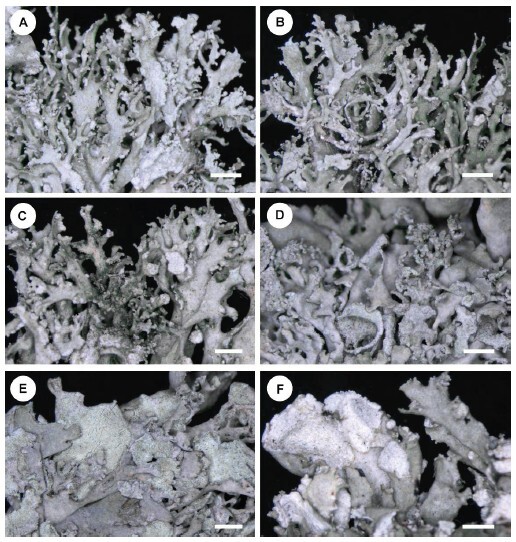
The Ramalina pollinaria group is comprised of three species in Poland: R. arsenii,
R. europaea and R. pollinaria. Their presence in the country is confirmed by sequencing
the nuITS rDNA barcode marker. Ramalina arsenii is reported from Poland for the first
time and this is the first corticolous record of this species. All species are characterized
and compared morphologically.
REFERENCES (36)
1.
Dietrich, M., Groner, U., Keller, C., Scheidegger, C., Vust, M. & Zimmermann, E. 2019. Beiträge zur lichenologischen Erforschung der Schweiz – Folge 1. Meylania 64: 7–21.
2.
Edgar, R. C. 2004. MUSCLE: multiple sequence alignment with high accuracy and high throughput. Nucleic Acids Research 32: 1792–1797. https://doi.org/10.1093/nar/gk....
3.
Fałtynowicz, W., Czarnota, P., Krzewicka, B., Wilk, K., Jabłońska, A., Oset, M. Ossowska, E. A., Śliwa, L. & Kukwa, M. 2024. Lichens of Poland. A fifth annotated checklist. W. Szafer Institute of Botany, Polish Academy of Sciences, Kraków. https://doi.org/10.35535/978-8....
4.
Galtier, N., Gouy, M. & Gautier, C. 1996. SeaView and Phylo_win: two graphic tools for sequence alignment and molecular phylogeny. Computer Applications in the Biosciences 12: 543–548. https://doi.org/10.1093/bioinf....
5.
Gardes, M. & Bruns, T. D. 1993. ITS primers with enhanced specificity for basidiomycetes-application to the identification of mycorrhizae and rust. Molecular Ecology 2: 113–118. https://doi.org/10.1111/j.1365....
6.
Gasparyan, A., Sipman, H. J. M. & Lücking, R. 2017. Ramalina europaea and R. labiosorediata, two new species of the R. pollinaria group (Ascomycota: Ramalinaceae), and new typifications for Lichen pollinarius and L. squarrosus. The Lichenologist 49: 301–319. https://doi.org/10.1017/S00242....
7.
Gouy, M., Guindon, S. & Gascuel, O. 2010. SeaView version 4: a multiplatform graphical user interface for sequence alignment and phylogenetic tree building. Molecular Biology and Evolution 27: 221–224. https://doi.org/10.1093/molbev....
8.
Guzow-Krzemińska, B. & Węgrzyn, G. 2000. Potential use of restriction analysis of PCR-amplified DNA fragments in taxonomy of lichens. Mycotaxon 76: 305–313. https://doi.org/10.5962/p.4147....
9.
Hoang, D. T., Chernomor, O., Von Haeseler, A., Minh, B. Q. & Vinh, L. S. 2018. UFBoot2: Improving the ultrafast bootstrap approximation. Molecular Biology and Evolution 35(2): 518–522. https://doi.org/10.1093/molbev....
10.
Huelsenbeck, J. P. & Ronquist, F. 2001. MRBAYES: Bayesian inference of phylogenetic trees. Bioinformatics 17: 754–755. https://doi.org/10.1093/bioinf....
11.
Kalyaanamoorthy, S., Minh, B. Q., Wong, T. K. F., von Haeseler, A. & Jermiin, L. S. 2017. ModelFinder: Fast model selection for accurate phylogenetic estimates. Nature Methods 14(6): 587–589. https://doi.org/10.1038/nmeth.....
12.
Kashiwadani, H., Moon, K. H., Han, J. E. & Takeshita, S. 2023. Three new Ramalina species (Ramalinaceae) from Japan and Korea. Journal of Japanese Botany 98: 304–318. https://doi.org/10.51033/jjapb....
13.
Khodosovtsev, A. & Darmostuk, V. 2020. Records of lichen species new for Ukraine from steppe habitats of the country. Botanica Serbica 44: 243–250. https://doi.org/10.2298/BOTSER....
14.
LaGreca, S., Lumbsch, H. T., Kukwa, M., Wei, X., Han, J. E., Moon, K. H., Kashiwadani, H., Aptroot, A. & Leavitt, S. D. 2020. A molecular phylogenetic evaluation of the Ramalina siliquosa complex, with notes on species circumscription and relationships within Ramalina. The Lichenologist 52: 197–211. https://doi.org/10.1017/S00242....
15.
Malíček, J., Palice, Z. & Vondrák, J. 2018. Additions and corrections to the lichen biota of the Czech Republic. Herzogia 31: 453–475. https://doi.org/10.13158/heia.....
16.
Martellos, S., Conti, M. & Nimis, P. L. 2023. Aggregation of Italian Lichen Data in ITALIC 7.0. Journal of Fungi 9(5): 556. https://doi.org/10.3390/jof905....
17.
Miller, M. A., Pfeiffer, W. & Schwartz, T. 2010. Creating the CIPRES Science Gateway for Inference of Large Phylogenetic Trees. Proceedings of the Gateway Computing Environments Workshop (GCE), 14 Nov., 2010, pp. 1–8. New Orleans. https://doi.org/10.1109/GCE.20....
18.
Moisejevs, R., Degtjarenko, P., Kaupuža, R., Krugļikova, A., Stepanova, D., Motiejūnaitė, J., Suija, A., Jüriado, I., Otte, V., Tsurykau, A., Thell, A. & Piterāns, A. 2024. Updates to the list of Latvian lichens and allied fungi, with four new records of lichens for the Baltic region. Herzogia 37: 320–327. https://doi.org/10.13158/heia.....
19.
Motiejūnaitė, J. 2024. New and noteworthy lichens from Lithuania. Botanica 30(2): 70–75. https://doi.org/10.35513/Botli....
20.
Motyka, J. 1962. Porosty. (Lichenes). 5.2. Usneaceae. Flora polska. Rośliny zarodnikowe Polski i ziem ościennych. Państwowe Wydawnictwo Naukowe, Warszawa.
21.
Nguyen, L. T., Schmidt, H. A., Von Haeseler, A. & Minh, B. Q. 2015. IQ-TREE: A fast and effective stochastic algorithm for estimating maximum-likelihood phylogenies. Molecular Biology and Evolution 32: 268–274. https://doi.org/10.1093/molbev....
22.
Nimis, P. L. 2016. The Lichens of Italy – a second annotated catalogue. EUT Edizioni Università di Trieste, Trieste.
23.
Nowak, J. & Tobolewski, Z. 1975. Porosty polskie. Opisy i klucze do oznaczania porostów w Polsce dotychczas stwierdzonych lub prawdopodobnych. Państwowe Wydawnictwo Naukowe, Kraków.
24.
Orange, A., James, P. W. & White, F. J. 2001. Microchemical Methods for the Identification of Lichens. British Lichen Society, London.
25.
Ossowska, E., Guzow-Krzemińska, B., Dudek, M., Oset, M. & Kukwa, M. 2018. Evaluation of diagnostic chemical and morphological characters in five Parmelia species (Parmeliaceae, lichenized Ascomycota) with special emphasis on the thallus pruinosity. Phytotaxa 383: 165–180. https://doi.org/10.11646/phyto....
26.
Ossowska, E., Guzow-Krzemińska, B., Kolanowska, M., Szczepańska, K. & Kukwa, M. 2019. Morphology and secondary chemistry in species recognition of Parmelia omphalodes group – evidence from molecular data with notes on the ecological niche modelling and genetic variability of photobionts. MycoKeys 61: 39–74. https://doi.org/10.3897/mycoke....
27.
Parker, S. R. 1997. AutoAssembler sequence assembly software. Methods in Molecular Biology 70: 107–117. https://doi.org/10.1385/0-8960....
29.
Ronquist, H. & Huelsenbeck, J. P. 2003. MrBayes 3: Bayesian phylogenetic inference under mixed models. Bioinformatics 19: 1572–1574. https://doi.org/10.1093/bioinf....
30.
Sérusiaux, E., van den Boom, P. & Magain, N. 2021. Ramalina arsenii, an additional new species in the R. pollinaria group in Western Europe. The Lichenologist 53: 433–439. https://doi.org/10.1017/S00242....
31.
Sharifi, M., Mehregan, I., Larijani, K., Sohrabi, M. & Sipman, H. 2025. A synopsis of the lichen genus Ramalina (Ramalinaceae) in Iran. Phytotaxa 702: 255–273. https://doi.org/10.11646/phyto....
32.
Smith, C. W., Aptroot, A., Coppins, B. J., Fletcher, A., Gilbert, O. L., James, P. W. & Wolseley, P. A. (eds). 2009. The lichens of Great Britain and Ireland. British Lichen Society, London.
33.
Spjut, R. W. 1995. Vermilacinia (Ramalinaceae, Lecanorales), a new genus of lichens. In: Daniëls, F. J. A., Schulz. M. & Peine. J. (eds), Flechten Follmann. Contributions to lichenology in Honour of Gerhard Follmann, pp. 337–351. Geobotanical and Phytotaxonomical Study Group, Botanical Institute, University of Cologne, Cologne.
34.
Spjut, R., Simon, A., Guissard, M., Magain, N. & Sérusiaux, E. 2020 The fruticose genera in the Ramalinaceae (Ascomycota, Lecanoromycetes): their diversity and evolutionary history. MycoKeys 73: 1–68. https://doi.org/10.3897/mycoke....
35.
Szymczyk, R., Ossowska, E. A., Guzow-Krzemińska, B., Zalewska, A., Kowalewska, A. & Kukwa, M. 2024. New and noteworthy lichen species in Poland. Acta Mycologica 59: 192460. https://doi.org/10.5586/am/192....
36.
White, T. J., Bruns, T., Lee, S. & Taylor, J. 1990. Amplification and direct sequencing of fungal ribosomal RNA genes for phylogenetics. In: Innis, M. A., Gelfand, D. H., Sninsky, J. J. & White, T. J. (eds), PCR Protocols: a Guide to Methods and Applications, pp. 315–322. Academic Press, New York. https://doi.org/10.1016/B978-0....
Share
RELATED ARTICLE
| eISSN: | 2657-5000 |
| ISSN: | 2544-7459 |


We process personal data collected when visiting the website. The function of obtaining information about users and their behavior is carried out by voluntarily entered information in forms and saving cookies in end devices. Data, including cookies, are used to provide services, improve the user experience and to analyze the traffic in accordance with the Privacy policy. Data are also collected and processed by Google Analytics tool (more).
You can change cookies settings in your browser. Restricted use of cookies in the browser configuration may affect some functionalities of the website.
You can change cookies settings in your browser. Restricted use of cookies in the browser configuration may affect some functionalities of the website.