ORIGINAL ARTICLE
Coccocarpia aptrootii, a new lichen species from Mauritius
1
National Museum of Natural History, 25 rue Munster, L-2160 Luxembourg,
Luxembourg
2
Meise Botanic Garden, Department of Research, Nieuwelaan 38,
1860 Meise, Belgium, and Fédération Wallonie-Bruxelles, Service
général de l’Enseignement supérieur et de la Recherche scientifique,
rue A. Lavallée 1, 1080 Bruxelles, Belgium
3
Natural History Museum, University of Oslo, P.O. Box 1172 Blindern,
0318 Oslo, Norway
Submission date: 2026-02-28
Acceptance date: 2026-06-23
Online publication date: 2026-07-31
Publication date: 2026-07-31
Plant and Fungal Systematics 2026; 71(1): 91-96
KEYWORDS
ABSTRACT
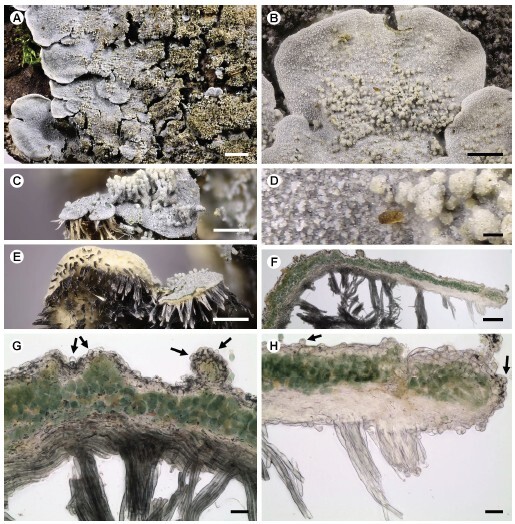
A new species of Coccocarpia is described from Mauritius based on morphological
and molecular evidence. The species is corticolous and currently known from four localities
in parkland and natural mountain forest habitats. It is characterized by comparatively large
thallus lobes, a distinctly pruinose upper surface, and abundant laminal isidia that are initially
subspherical and later elongate into cylindrical to coralloid structures. Phylogenetic analysis
of nuclear ITS rDNA sequences places the Mauritian material as a distinct lineage within
Coccocarpia, not nested within any currently sampled species-level clade. The combined
morphological distinctiveness and molecular differentiation support its recognition as a new
species, here described as Coccocarpia aptrootii. This discovery further demonstrates that
species diversity in Coccocarpia remains underestimated, particularly in tropical regions.
REFERENCES (13)
1.
Arvidsson, L. 1983 [‘1982’]. A monograph of the lichen genus Coccocarpia. Opera Botanica 67: 1–96.
2.
Coca, L. F., Lumbsch, H. T., Marcado-Díaz, J. A., Widhelm, T. J., Goffinet, B., Kirika, P. & Lücking, R. 2025. Diversity, phylogeny, and historical biogeography of the genus Coccocarpia (lichenized Ascomycota: Peltigerales) in the tropics. Molecular Phylogenetics and Evolution 206: 108312. https://doi.org/10.1016/j.ympe....
3.
Darriba, D., Taboada, G. L., Doallo, R. & Posada, D. 2012. jModelTest2: more models, new heuristics and parallel computing. Nature Methods 9: 772. https://doi.org/10.1038/nmeth.....
4.
Diederich, P. & Ertz, D. 2020. First checklist of lichens and lichenicolous fungi from Mauritius, with phylogenetic analyses and description of new taxa. Plant and Fungal Systematics 65(1): 13–75. https://doi.org/10.35535/pfsys....
5.
Ertz, D., Tehler, A., Irestedt, M., Frisch, A., Thor, G. & van den Boom, P. 2015. A large-scale phylogenetic revision of Roccellaceae (Arthoniales) reveals eight new genera. Fungal Diversity 70: 31–53. https://doi.org/10.1007/s13225....
6.
Ertz, D., Sanderson, N., Łubek, A. & Kukwa, M. 2018. Two new species of Arthoniaceae from old-growth European forests, Arthonia thoriana and Inoderma sorediatum, and a new genus for Schismatomma niveum. The Lichenologist 50: 161–172. https://doi.org/10.1017/S00242....
7.
Gardes, M. & Bruns, T. D. 1993. ITS primers with enhanced specificity for basidiomycetes, application to the identification of mycorrhizae and rusts. Molecular Ecology 2: 113–118. https://doi.org/10.1111/j.1365....
8.
Katoh, K., Misawa, K., Kuma, K. & Miyata, T. 2002. MAFFT: a novel method for rapid multiple sequence alignment based on fast Fourier transform. Nucleic Acids Research 30: 3059–3066. https://doi.org/10.1093/nar/gk....
9.
Maddison, W. P. & Maddison, D. R. 2025. Mesquite: a modular system for evolutionary analysis. Version 4.01. Available from: https://www.mesquiteproject.or....
10.
Miller, M. A., Pfeiffer, W. & Schwartz, T. 2010. Creating the CIPRES Science Gateway for inference of large phylogenetic trees. In: Proceedings of the Gateway Computing Environments Workshop (GCE), 14 Nov. 2010, New Orleans, pp. 1–8. https://doi.org/10.1109/GCE.20....
12.
Stamatakis, A. 2014. RAxML version 8: a tool for phylogenetic analysis and post-analysis of large phylogenies. Bioinformatics 30: 1312–1313. https://doi.org/10.1093/bioinf....
13.
White, T. J., Bruns, T., Lee, S. B. & Taylor, J. W. 1990. Amplification and direct sequencing of fungal ribosomal RNA genes for phylogenetics. In: Innis, M. A., Gelfand, D. H., Sninsky. J. J. & White, T. J. (eds), PCR Protocols: a Guide to Methods and Applications. New York: Academic Press, pp. 315–322. https://doi.org/10.1016/B978-0....
Share
RELATED ARTICLE
| eISSN: | 2657-5000 |
| ISSN: | 2544-7459 |


We process personal data collected when visiting the website. The function of obtaining information about users and their behavior is carried out by voluntarily entered information in forms and saving cookies in end devices. Data, including cookies, are used to provide services, improve the user experience and to analyze the traffic in accordance with the Privacy policy. Data are also collected and processed by Google Analytics tool (more).
You can change cookies settings in your browser. Restricted use of cookies in the browser configuration may affect some functionalities of the website.
You can change cookies settings in your browser. Restricted use of cookies in the browser configuration may affect some functionalities of the website.