ORIGINAL ARTICLE
A new lignicolous species of Micarea (Lecanoromycetes, Ectolechiaceae) from Sweden
1
Museum of Evolution, Uppsala University, Norbyvägen 16, SE-752
36 Uppsala, Sweden
Submission date: 2026-03-30
Acceptance date: 2026-06-09
Online publication date: 2026-09-08
Publication date: 2026-09-08
Plant and Fungal Systematics 2026; 71(2): 332-339
KEYWORDS
ABSTRACT
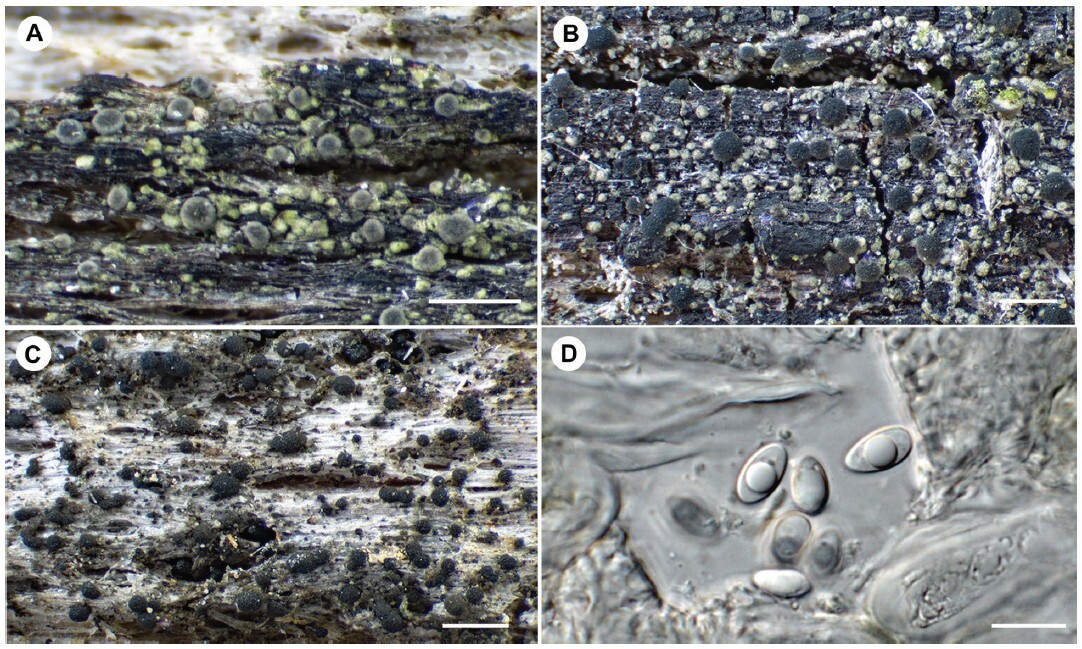
The new lignicolous species Micarea latispora is described from central Sweden
based on morphological and molecular evidence. The species grows on decaying wood of
deciduous trees, particularly Populus tremula, in open to semi-shaded conditions, and is
characterized by Sedifolia-grey pigmentation in the epithecium and hymenium, unicellular,
often ovoid ascospores, and by containing gyrophoric acid. It is similar to M. misella, from
which it differs in having broader ascospores [(3–)3.5–4.5(–5) μm wide vs. 2–3(–3.5) μm
in M. misella], a better developed thallus containing gyrophoric acid, and the absence of
stipitate pycnidia. Micarea denigrata, which also contains gyrophoric acid and has similar
apothecia, differs by having narrower ascospores [2–3.5(–4) μm] that are predominantly
1-septate rather than unicellular. Micarea latispora is currently known from three provinces
in central Sweden, but is likely more widespread and may have been overlooked due to its
superficial resemblance to related species.
FUNDING
This research was financially supported by the Swedish Taxonomy
Initiative (2016-206 4.3 and 2023.4.3-30).
REFERENCES (30)
1.
Brand, A. M., van den Boom, P. P. G. & Sérusiaux, E. 2014. Unveiling a surprising diversity in the lichen genus Micarea (Pilocarpaceae) in Réunion (Mascarenes archipelago, Indian Ocean). The Lichenologist 46: 413–439. https://doi.org/10.1017/S00242....
2.
Cannon, P., Orange, A., Aptroot, A., Sanderson, N., Coppins, B. & Simkin, J. 2022. Lecanorales: Pilocarpaceae, including the genera Aquacidia, Byssoloma, Fellhanera, Fellhaneropsis, Leimonis and Micarea. Revisions of British and Irish Lichens 27: 1–48. https://britishlichensociety.o....
3.
Coppins, B. J. 1983. A taxonomic study of the lichen genus Micarea in Europe. Bulletin of the British Museum (Natural History), Botany 11: 17–214.
4.
Coppins, B. J. 2008. Micarea perparvula in North America. Opuscula Philolichenum 23: 23–24.
5.
Coppins, B. J., Kashiwadani, H., Moon, K. H., Spribille, T. & Thor, G. 2021. The genera Brianaria (Psoraceae) and Micarea (Pilocarpaceae) in Japan, with reports on other interesting species in Asia. The Lichenologist 53: 35–44. https://doi.org/10.1017/S00242....
6.
Coppins, B. J. & van den Boom, P. P. G. 1995. Micarea confusa: A new species from zinc- and cadmium-contaminated soils in Belgium and the Netherlands. The Lichenologist 27: 81–90. https://doi.org/10.1006/lich.1....
7.
Czarnota, P. 2007. The lichen genus Micarea (Lecanorales, Ascomycota) in Poland. Polish Botanical Studies 23: 1–199.
8.
Czarnota, P. & Guzow-Krzemińska, B. 2010. A phylogenetic study of the Micarea prasina group shows that Micarea micrococca includes three distinct lineages. The Lichenologist 42: 7–21. https://doi.org/10.1017/S00242....
9.
Guzow-Krzemińska, B., Sérusiaux, E., van den Boom, P. P. G., Brand, A. M., Launis, A., Łubek, A. & Kukwa, M. 2019. Understanding the evolution of phenotypical characters in the Micarea prasina group (Pilocarpaceae) and descriptions of six new species within the group. MycoKeys 57: 1–30. https://doi.org/10.3897/mycoke....
10.
Kalyaanamoorthy, S., Minh, B. Q., Wong, T. K. F., von Haeseler, A. & Jermiin, L. S. 2017. ModelFinder: Fast model selection for accurate phylogenetic estimates. Nature Methods 14: 587–589. https://doi.org/10.1038/nmeth.....
11.
Kantelinen, A., Hyvärinen, M., Kirika, P. & Myllys, L. 2021. Four new Micarea species from the montane cloud forests of Taita Hills, Kenya. The Lichenologist 53: 81–94. https://doi.org/10.1017/S00242....
12.
Kantelinen, A., Printzen, C., Poczai, P. & Myllys, L. 2022. Lichen speciation is sparked by a substrate requirement shift and reproduction mode differentiation. Scientific Reports 12: 11048. https://doi.org/10.1038/s41598....
13.
Kantelinen, A., Svensson, M., Malíček, J., Vondrák, J., Thor, G., Palice, Z., Svoboda, S. & Myllys, L. 2024. A phylogenetic study of Micarea melaeniza and similar-looking species (Pilocarpaceae) unveils hidden diversity and clarifies species boundaries and reproduction modes. MycoKeys 106: 327–354. https://doi.org/10.3897/mycoke....
14.
Kantvilas, G. & Coppins, B. J. 2019. Studies on Micarea in Australasia II: A synopsis of the genus in Tasmania, with the description of ten new species. The Lichenologist 51: 431–481. https://doi.org/10.1017/S00242....
15.
Katoh, K., Rozewicki, J. & Yamada, K. D. 2019. MAFFT online service: multiple sequence alignment, interactive sequence choice and visualization. Briefings in Bioinformatics 20: 1160–1166. https://doi.org/10.1093/bib/bb....
16.
Launis, A., Malíček, J., Svensson, M., Tsurykau, A., Sérusiaux, E. & Myllys, L. 2019a. Sharpening species boundaries in the Micarea prasina group, with a new circumscription of the type species M. prasina. Mycologia 111: 574–592. https://doi.org/10.1080/002755....
17.
Launis, A., Pykälä, J., van den Boom, P., Sérusiaux, E. & Myllys, L. 2019b. Four new epiphytic species in the Micarea prasina group from Europe. The Lichenologist 51: 7–25. https://doi.org/10.1017/S00242....
18.
Malíček, J. 2022. Lišejníky přírodní rezervace Getsemanka v Brdech. [Lichens of the Getsemanka Nature Reserve in the Brdy Hills.] Bryonora 69: 19–29.
19.
Mason-Gamer, R. J. & Kellogg, E. A. 1996. Testing for phylogenetic conflict among molecular data sets in the tribe Triticeae (Gramineae). Systematic Biology 45: 524–545. https://doi.org/10.1093/sysbio....
20.
Meyer, B. & Printzen, C. 2000. Proposal for a standardized nomenclature and characterization of insoluble lichen pigments. The Lichenologist 32: 571–583. https://doi.org/10.1006/lich.2....
21.
Miadlikowska, J., Kauff, F., Högnabba, F., Oliver, J. C., Molnár, K., Fraker, E., Gaya, E., Hafellner, J., Hofstetter, V., Gueidan, C., Otálora, M. A., Hodkinson, B., Kukwa, M., Lücking, R., Björk, C., Sipman, H. J., Burgaz, A. R., Thell, A., Passo, A., Myllys, L., Goward, T., Fernández-Brime, S., Hestmark, G., Lendemer, J., Lumbsch, H. T., Schmull, M., Schoch, C. L., Sérusiaux, E., Maddison, D. R., Arnold, A. E., Lutzoni, F. & Stenroos, S. 2014. A multigene phylogenetic synthesis for the class Lecanoromycetes (Ascomycota): 1307 fungi representing 1139 infrageneric taxa, 317 genera and 66 families. Molecular Phylogenetics and Evolution 79: 132–168. https://doi.org/10.1016/j.ympe....
22.
Mirarab, S., Nguyen, N., Guo, S., Wang, L. S., Kim, J. & Warnow, T. 2015. PASTA: ultra-large multiple sequence alignment for nucleotide and amino-acid sequences. Journal of Computational Biology 22: 377–386. https://doi.org/10.1089/cmb.20....
23.
Myllys, L., Svensson, M., Kantvilas, G., Sérusiaux, E., van den Boom, P., Aptroot, A., Cezanne, R., Eichler, M., Pino-Bodas, R., Printzen, C., Pykälä, J., Thor, G., Westberg, M., Weber, L. & Kantelinen, A. 2026. The first comprehensive multilocus phylogeny of the lichenized genus Micarea (Ectolechiaceae, Ascomycota). Taxon 75: e70087. https://doi.org/10.1002/tax.70....
24.
Orange, A., James, P. W. & White, F. J. 2010. Microchemical methods for the identification of lichens, 2nd ed. British Lichen Society.
25.
Schmitt, I., Crespo, A., Divakar, P. K., Fankhauser, J. D., Herman-Sackett, E., Kalb, K., Nelsen, M. P., Nelson, N. A., Rivas-Plata, E., Shimp, A. D., Widhelm, T. & Lumbsch, H. T. 2009. New primers for promising single-copy genes in fungal phylogenetics and systematics. Persoonia 23: 35–40. https://doi.org/10.3767/003158....
26.
Svensson, M. & Fryday, A. 2022. Gilbertaria, a first crustose genus in the Sphaerophoraceae (Lecanoromycetes, Ascomycota) for Catillaria contristans, Toninia squalescens and related species. Mycological Progress 21: 90. https://doi.org/10.1007/s11557....
27.
van den Boom, P. P. G., Brand, A. M., Coppins, B. J. & Sérusiaux, E. 2017. Two new species in the Micarea prasina group from Western Europe. The Lichenologist 49: 13–25. https://doi.org/10.1017/S00242....
28.
van den Boom, P. P. G., Guzow-Krzemińska, B. & Kukwa, M. 2020. Two new Micarea species (Pilocarpaceae) from Western Europe. Plant and Fungal Systematics 65: 189–199. https://doi.org/10.35535/pfsys....
29.
Vondrák, J., Svoboda, S., Košnar, J., Malíček, J., Šoun, J., Frolov, J., Svensson, M., Novotný, P. & Palice, Z. 2023. Martin7: a reference database of DNA barcodes for European epiphytic lichens and its taxonomic implications. Preslia 95: 311–345. https://doi.org/10.23855/presl....
30.
Wong, T. K. F., Ly-Trong, N., Ren, H., Banos, H., Roger, A. J., Susko, E., Bielow, C., De Maio, N., Goldman, N., Hahn, M. W., Huttley, G., Lanfear, R. & Quang Minh, B. 2025. IQ-TREE 3: phylogenomic inference software using complex evolutionary models (preprint). ecoevoRxiv. https://doi.org/10.32942/X2P62....
Share
RELATED ARTICLE
| eISSN: | 2657-5000 |
| ISSN: | 2544-7459 |


We process personal data collected when visiting the website. The function of obtaining information about users and their behavior is carried out by voluntarily entered information in forms and saving cookies in end devices. Data, including cookies, are used to provide services, improve the user experience and to analyze the traffic in accordance with the Privacy policy. Data are also collected and processed by Google Analytics tool (more).
You can change cookies settings in your browser. Restricted use of cookies in the browser configuration may affect some functionalities of the website.
You can change cookies settings in your browser. Restricted use of cookies in the browser configuration may affect some functionalities of the website.