ORIGINAL ARTICLE
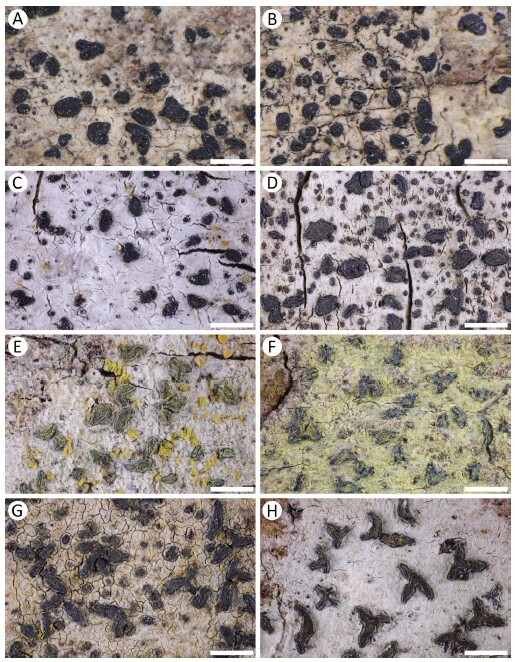
Morphological evidence for the distinction of Alyxoria lichenoides and A. viridipruinosa from A. varia
1
Dutch Bryological and Lichenological Society, Utrecht, the Netherlands
Submission date: 2026-03-04
Acceptance date: 2026-06-08
Online publication date: 2026-07-31
Publication date: 2026-07-31
Plant and Fungal Systematics 2026; 71(1): 29-41
KEYWORDS
ABSTRACT
The epiphytic lichen Alyxoria varia is often interpreted as an extremely variable
species or as a complex of multiple species that is not yet well understood. Alyxoria lichenoides
is sometimes recognized as a separate species, and recently Alyxoria viridipruinosa was
newly described. However, it is still poorly known which characteristics are useful to
distinguish these species from A. varia. Here, we studied and measured morphological
characteristics of 83 specimens of A. varia s.l., mainly from the Netherlands, but with
some additional specimens from other European countries. We measured the dimensions
of the lirellae, ascospores and conidia. We found that Alyxoria lichenoides, A. varia and
A. viridipruinosa can be reliably separated by differences in the size of their conidia.
There are also differences in the size of the lirellae, size of the pycnidia and ascospores,
but due to overlap not all specimens can be identified based on those characteristics alone.
Alyxoria lichenoides and A. viridipruinosa are very variable species with respect to the
abundance of pycnidia, size and shape of the lirellae, thallus color and pruina presence. Some
morphotypes can, however, still be identified with certainty in the field. Alyxoria lichenoides
is currently one of the most common epiphytic lichens in the Netherlands, especially in
coastal areas. It occurs in woodlands, parks and on roadside trees. Alyxoria viridipruinosa
occurs in similar habitats, but is somewhat scarcer, and due to its smaller size and generally
inconspicuous thallus easily overlooked. Alyxoria varia is rare in the Netherlands and
occurs in drier habitats. It prefers woodlands and parks and is not bound to coastal areas.
We recommend that lichenologists in Europe distinguish Alyxoria varia, A. viridipruinosa
and A. lichenoides as three separate species. Future studies that include molecular data
could reveal whether even more species are involved.
REFERENCES (19)
1.
Aragón, G., Martínez, I., de la Cruz, M. & Hurtado, P. 2025. High Host Preferences in Epiphytic Lichens Across Diverse Phorophyte Species in the Mediterranean Region. Journal of Fungi 11: 104. https://doi.org/10.3390/jof110....
2.
Cannon, P., Coppins, B., Ertz, D., Pentecost, A., Sanderson, N., Simkin, J. & Wolseley, P. 2021. Arthoniales: Lecanographaceae, including the genera Alyxoria, Lecanographa, Phacographa, Plectocarpon and Zwackhia. Revisions of British and Irish Lichens 14: 1–15.
3.
Erichsen, C. F. E. 1957. Flechtenflora von Nordwestdeutschland. Stuttgart: Gustav Fischer.
4.
Ertz, D. & Tehler, A. 2011. The phylogeny of Arthoniales (Pezizomycotina) inferred from nucLSU and rpb2 sequences. Fungal Diversity 49: 47–71. https://doi.org/10.1007/s13225....
5.
Ertz, D., Miadlikowska, J., Lutzoni, F., Dessein, S., Raspé, O., Vigneron, N., Hofstetter, V. & Diederich, P. 2009. Towards a new classification of the Arthoniales (Ascomycota) based on a three-gene phylogeny focussing on the genus Opegrapha. Mycological Research 113: 141–152. https://doi.org/10.1016/j.mycr....
6.
Lumbsch, H. T., Ahti, T., Altermann, S., De Paz, G. A., Aptroot, A., Arup, U., et al. 2011. One hundred new species of lichenized fungi: a signature of undiscovered global diversity. Phytotaxa 18: 1–127. https://doi.org/10.11646/phyto....
7.
Pentecost, A. & Coppins, B. J. 1983. Key to Opegrapha in Great Britain. Bulletin of the British Lichen Society 53: 27–35.
8.
Persoon, C. H. 1794. Einige Bemerkungen über die Flechten. Annalen der Botanik (Usteri) 7: 1–32.
9.
Persoon, C. H. 1810. Novae lichenum species. Annalen der Wetterauischen Gesellschaft für die Gesammte Naturkunde 2: 9–20.
11.
Roux, C., et coll. 2025. Catalogue des lichens et champignons lichénicoles de France métropolitaine. 4e édition revue et augmentée (2025). Édit. Claude Roux, Mirabeau (Vaucluse), 2015 p.
12.
Schiefelbein, U., Dolnik, C., De Bruyn, U., Schultz, M., Thiemann, R., Stordeur, R., van den Boom, P. P. G., Litterski, B. & Sipman, H. J. M. 2014. Interesting records of lichenized, lichenicolous and saprophytic fungi from northern Germany. Herzogia 27: 237–256. https://doi.org/10.13158/heia.....
13.
Smith, C. W., Aptroot, A., Coppins, B. J., Fletcher, A., Gilbert, O. L., James, R. W. & Wolseley, P. A. 2009. The lichens of Britain and Ireland. British Lichen Society, London, UK.
14.
Timmerman, H. & Aptroot, A. 2012. Een recent uit Engeland beschreven soort, Opegrapha viridipruinosa (Limoenschriftmos) komt ook in Nederland voor. Buxbaumiella 93: 26–32.
15.
Toussaint, B., Cocquempot, M. & Van Haluwyn, C. 2021. Contribution à l’inventaire des lichens et champignons lichénicoles de la région Hauts-de-France. Bulletin de l’Association Française de Lichénologie 46: 165–226.
16.
van der Kolk, H., Verboom, L. & Sparrius, L. B. 2025. Effecten van ammoniak op korstmossen in Zeeland in de periode 1997–2025. BLWG-rapport 46: 1–129.
17.
Verboom, L., van der Kolk, H. & Sparrius, L. B. 2025. Effecten van ammoniak op korstmossen in Zuid-Holland in 2024. BLWG-rapport 45: 1–51.
18.
Wirth, V., Hauck, M. & Schultz, M. 2013. Die Flechten Deutschlands. Band 1 und 2. Verlag Eugen Ulmer.
19.
Wieczorek, A. 2018. The lichen genus Opegrapha s.l. in Poland: morphological variability, ecology, and distribution. Monographiae Botanicae 107: 1–162.
Share
RELATED ARTICLE
| eISSN: | 2657-5000 |
| ISSN: | 2544-7459 |


We process personal data collected when visiting the website. The function of obtaining information about users and their behavior is carried out by voluntarily entered information in forms and saving cookies in end devices. Data, including cookies, are used to provide services, improve the user experience and to analyze the traffic in accordance with the Privacy policy. Data are also collected and processed by Google Analytics tool (more).
You can change cookies settings in your browser. Restricted use of cookies in the browser configuration may affect some functionalities of the website.
You can change cookies settings in your browser. Restricted use of cookies in the browser configuration may affect some functionalities of the website.