ORIGINAL ARTICLE
Monitoring the effects of ammonia air pollution with epiphytic lichens in the Netherlands, 1989–2022, a review
1
Lichenologisch Onderzoekbureau Nederland (LON), Wielewaal 42,
3766 VC Soest, the Netherlands
2
Dutch Bryological and Lichenological Society (BLWG), Bereklauw
93, 6721 RH Bennekom, the Netherlands
3
Dutch Bryological and Lichenological Society (BLWG), Hollandse
Toren 40, 3511 BN Utrecht, the Netherlands
Submission date: 2026-03-25
Acceptance date: 2026-06-14
Online publication date: 2026-07-31
Publication date: 2026-07-31
Plant and Fungal Systematics 2026; 71(1): 83-90
KEYWORDS
ABSTRACT
This paper deals with the results of long-term lichen monitoring in the Netherlands.
We review the results related to ammonia (NH3) air pollution over the period 1989–2022.
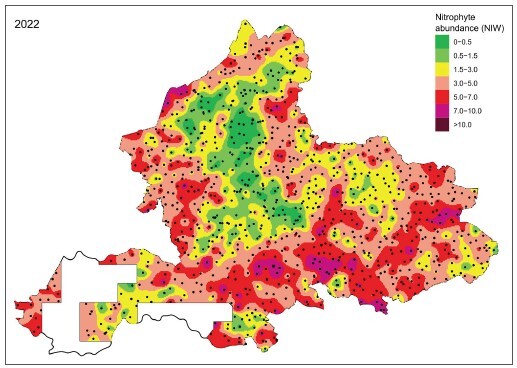
NIW (nitrophyte abundance) and AIW (acidophyte abundance) were used as parameters to
unite lichens with positive and negative responses to ammonia, respectively. Spatial patterns
and temporal changes at large numbers of sampling sites with Oaks (Quercus robur) are
compared and discussed. A steady decrease of acidophyte abundance (AIW) since 1989
is apparent, and continues up to now. The way in which AIW behaves strongly suggests
that de-acidification of tree bark is the main cause of decline. This process is likely to be
cumulative, i.e., proceeds as long as ammonia pollution continues. Recovery of bark acidity
and acidophytic epiphytes is unlikely under current conditions. Loss of acidophytes is
considered to be an important warning signal for habitat degradation. Changes in nitrophyte
abundance (NIW) are not just the opposite of the AIW. Until 1998, there was a marked
increase in nitrophyte abundance. After reaching its maximum in 1999, the NIW decreased
again by 25–30%, probably as a result of measures to control the ammonia emissions.
Nitrophytes had initially (< 1999) increased fast due to the rapid de-acidification of tree
bark. Many sites, at least in areas with high cattle densities, were fully de-acidified over the
last 25 years. Measurements show that de-acidification eventually stops at a pH of about
6 or 6.5. Nitrophytes can be dominant at such sites, but can also disappear again, leaving
a community with mainly crustose species typical for neutral bark. This is probably caused
by a decrease in available nitrogen. Recent (since 2000) temporal changes of nitrophyte
abundance (NIW) are likely reflecting changes in the load of ammonia.
REFERENCES (18)
1.
Aptroot, A., Sparrius, L. B. & Verboom, L. 2025. Epifytische korstmossen en mossen in het Noord-Hollands Duinreservaat 1990–2025. BLWG-rapport 41: 1–150. Available at: https://natuurtijdschriften.nl....
2.
Asman, W. A. H. & van Jaarsveld, J. A. 1990. A variable-resolution statistical transport model applied for ammonia and ammonium. RIVM report no. 228471007. Rijksinstituut voor Volksgezondheid en Milieuhygiene, Bilthoven.
3.
Barkman, J. J. 1958. Phytosociology and Ecology of Cryptogamic Epiphytes. Van Gorcum, Assen.
4.
Boers, J. 2023. Nitrogen availability and bark pH as separate pathways via which nitrogen pollution affects epiphytic lichen communities. Master thesis. Wageningen University and Research & BLWG, Utrecht.
5.
de Wit, T. 1976. Epiphytic lichens and air pollution in the Netherlands. Bibliotheca Lichenologica 5: 1–115.
6.
Gadsdon, S. R., Dagley, J. R., Wolseley, P. A. & Power, S. A. 2010. Relationships between lichen community composition and concentrations of NO2 and NH3. Environmental Pollution 158: 2553–2560. https://doi.org/10.1016/j.envp....
7.
Larsen, R. S., Bell, J. N. B., James, P. W., Chimonides, P. J., Rumsey, F. J., Tremper, A. & Purvis, O. W. 2007. Lichen and bryophyte distribution on oak in London in relation to air pollution and bark acidity. Environmental Pollution 146: 332–340. https://doi.org/10.1016/j.envp....
8.
Sparrius, L. B. 2007. Response of epiphytic lichen communities to decreasing ammonia air concentrations in a moderately polluted area of the Netherlands. Environmental Pollution 146: 375–379. https://doi.org/10.1016/j.envp....
9.
van der Knaap, W. O. 1980. Onderzoek naar epifytische lichenen en mossen in de provincie Utrecht in 1979. Provinciale Waterstaat Utrecht.
10.
van der Kolk, H., Sparrius,L. B. & van Herk,C. M. 2022. Effecten van ammoniak op korstmossen in Gelderland in de periode 1989–2022. BLWG-rapport 31: 1–107. Available at: https://natuurtijdschriften.nl....
11.
van Dobben, H. F. 1993. Vegetation as a monitor for deposition of nitrogen and acidity. Ph.D. Thesis. University of Utrecht.
12.
van Dobben, H. F. & ter Braak, C. J. F. 1998. Effects of atmospheric NH3 on epiphytic lichens in the Netherlands: the pitfalls of biological monitoring. Atmospheric Environment 32: 551–557. https://doi.org/10.1016/S1352-....
13.
van Herk, C. M. 1999. Mapping of ammonia pollution with epiphytic lichens in the Netherlands. The Lichenologist 31: 9–20. https://doi.org/10.1017/S00242....
14.
van Herk, C. M. 2001. Bark pH and susceptibility to toxic air pollutants as independent causes of changes in epiphytic lichen composition in space and time. The Lichenologist 33: 419–441. https://doi.org/10.1006/lich.2....
15.
van Herk, C. M. 2019. Teloorgang van epifyten in de bossen op de Utrechtse Heuvelrug. Buxbaumiella 115: 14–22. Available at: https://natuurtijdschriften.nl....
16.
van Herk, K. 2022. Monitoring the impacts of ammonia air pollution on epiphytic lichens in the Netherlands (and across Europe). Keynote presentation at CAPER Conference, 22–23 March 2022, Swansea, UK. https://doi.org/10.13140/RG.2.....
17.
van Herk, C. M., Aptroot, A. & van Dobben, H. F. 2002. Long-term monitoring in the Netherlands suggests that lichens respond to global warming. The Lichenologist 34: 141–154. https://doi.org/10.1006/lich.2....
18.
van Herk, C. M., Mathijssen-Spiekman, E. A. M. & de Zwart, D. 2003. Long-distance nitrogen air pollution effects on lichens in Europe. The Lichenologist 35: 347–359. https://doi.org/10.1016/S0024-....
| eISSN: | 2657-5000 |
| ISSN: | 2544-7459 |


We process personal data collected when visiting the website. The function of obtaining information about users and their behavior is carried out by voluntarily entered information in forms and saving cookies in end devices. Data, including cookies, are used to provide services, improve the user experience and to analyze the traffic in accordance with the Privacy policy. Data are also collected and processed by Google Analytics tool (more).
You can change cookies settings in your browser. Restricted use of cookies in the browser configuration may affect some functionalities of the website.
You can change cookies settings in your browser. Restricted use of cookies in the browser configuration may affect some functionalities of the website.