ORIGINAL ARTICLE
Phenotypic and phylogenetic evidence reveals the position of Parmelia skultii in a new monotypic genus Arneparmelia within Parmeliaceae
1
Department of Plant Taxonomy and Nature Conservation, Faculty of
Biology, University of Gdańsk, Wita Stwosza 59, 80-308 Gdańsk,
Poland
Submission date: 2026-05-04
Acceptance date: 2026-06-29
Online publication date: 2026-09-04
Publication date: 2026-09-04
Plant and Fungal Systematics 2026; 71(2): 319-331
KEYWORDS
ABSTRACT
The new monotypic genus Arneparmelia is introduced on the basis of phylogenetic
and phenotypic evidence. The new combination, A. skultii, is proposed. Phylogenetic
analyses using nuITS, nuLSU, mtSSU, and mcm7 markers place the new genus close to
Parmelia and Notoparmelia, although relationships among these genera remain incompletely
resolved. The distinction between these three lineages as separate genera is also reflected
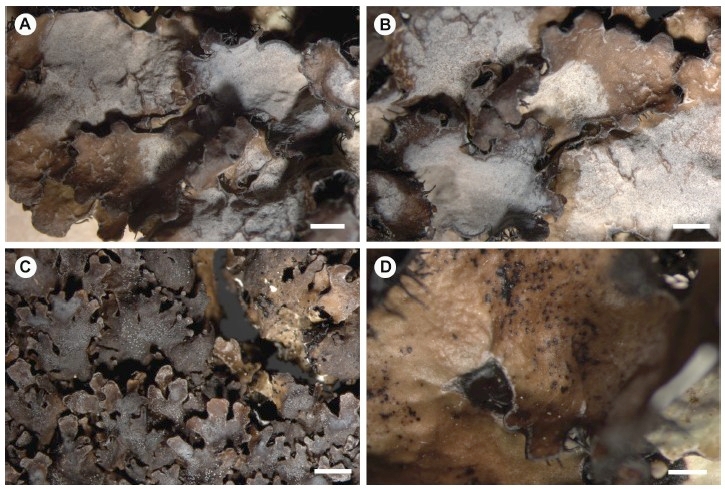
in their morphological, chemical and geographical differences. Arneparmelia is characterized
by a foliose, dark brown to black thallus with a black, stiff rim around the lobes, the
upper surface covered by a bluish-white to lilac pruina and with silver, marginal or rarely
laminal pseudocyphellae and by the presence of norstictic acid in high concentrations.
The thalli of most species belonging to Parmelia and Notoparmelia exhibit a range of
grey shades. The presence of a black margin is rarely observed and is found in only a few
Parmelia species, and it is always absent in Notoparmelia. The pruina is always absent in
Notoparmelia, and, when it is present in Parmelia species, its color is white. The presence
of norstictic acid is rare and it is never present in high concentration in Parmelia and the
substance is absent in Notoparmelia. The distribution of Arneparmelia is predominantly
Arctic-Alpine. Species of the genus Parmelia are widely distributed, but Notoparmelia
occurs in the Southern Hemisphere.
REFERENCES (81)
3.
Altschul, S. F., Gish, W., Miller, W., Myers, E. W. & Lipman, D. J. 1990. Basic local alignment search tool. Journal of Molecular Biology 215: 403–410. https://doi.org/10.1016/S0022-....
4.
Blanco, O., Crespo, A., Divakar, P. K., Esslinger, T. L., Hawksworth, D. L. & Lumbsch, H. T. 2004. Melanelixia and Melanohalea, two new genera segregated from Melanelia (Parmeliaceae) based on molecular and morphological data. Mycological Research 108(8): 873–884. https://doi.org/10.1017/S09537....
5.
Buaruang, K., Scharnagl, K., Divakar, P. K., Leavitt, S. D., Crespo, A., Nash, T., Manoch, L., Lücking, R. & Lumbsch, H. T. 2015. Molecular data support Pseudoparmelia as a distinct lineage related to Relicina and Relicinopsis (Ascomycota, Lecanorales). The Lichenologist 47(1): 43–49. https://doi.org/10.1017/S00242....
6.
Castellani, M. B., Bianchi, E., Coppi, A., Nascimbene, J. & Benasperi, R. 2021. Revision of the Parmelia saxatilis group in Italy based on morphological, chemical and molecular data. Phytotaxa 512: 28–40. https://doi.org/10.11646/phyto....
7.
Castresana, J. 2000. Selection of conserved blocks from multiple alignments for their use in phylogenetic analysis. Molecular Biology and Evolution 17: 540‒552. https://doi.org/10.1093/oxford....
8.
Chernomor, O., von Haeseler, A. & Minh, B. Q. 2016. Terrace aware data structure for phylogenomic inference from supermatrices. Systematic Biology 65: 997–1008. https://doi.org/10.1093/sysbio....
9.
Chesnokov, S. V., Davydov, E. A., Konoreva, L. A., Prokopiev, I. A., Poryadina, L. N., Zheludeva, E. V. & Shavarda, A. L. 2023 The monotypic genus Flavocetraria and two new genera: Cladocetraria and Foveolaria, in the cetrarioid core. Plant Systematics and Evolution 309: 24. https://doi.org/10.1007/s00606....
10.
Chesnokov, S. V., Etylina, A. S. & Konoreva, L. A. 2025. Addition to the lichen flora of the Chukotka Autonomous Area, North of the Russian Far East. Novosti Sistematiki Nizshikh Rastenii 59(1): L73–L79. https://doi.org/10.31111/nsnr/....
11.
Corsie, E. I., Harrold, P. & Yahr, R. 2019. No combination of morphological, ecological or chemical characters can reliably diagnose species in the Parmelia saxatilis aggregate in Scotland. The Lichenologist 51: 107–121. https://doi.org/10.1017/S00242....
12.
Crespo, A., Kauff, F., Divakar, P. K., Del-Prado, R., Pérez-Ortega, S., Amo de Paz, G., Ferencova, Z., Blanco, O., Roca-Valiente, B., Núñez-Zapata, J., Cubas, P., Argüello, A., Elix, J. A., Esslinger, T. L., Hawksworth, D. L., Millanes, A., Molina, M. C., Wedin, M., Ahti, T., Aptroot, A., Barreno, E., Bungartz, F., Calvelo, S., Candan, M., Cole, M., Ertz, D., Goffinet, B., Lindblom, L., Lücking, R., Lutzoni, F., Mattsson, J.-E., Messuti, M. I., Miadlikowska, J., Piercey-Normore, M., Rico, V. J., Sipman, H. J. M., Schmitt, I., Spribille, T., Thell, A., Thor, G., Upreti, D. K. & Lumbsch, H. T. 2010. Phylogenetic generic classification of parmelioid lichens (Parmeliaceae, Ascomycota) based on molecular, morphological and chemical evidence. Taxon 59: 1735–1753. https://doi.org/10.1002/tax.59....
13.
Crespo, A., Rico, V. J., Garrido, E., Lumbsch, H. T. & Divakar, P. K. 2020. A revision of species of the Parmelia saxatilis complex in the Iberian Peninsula with the description of P. rojoi, a new potentially relict species. The Lichenologist 52: 365–376. https://doi.org/10.1017/S00242....
14.
Divakar, P. K., Molina, M. C., Lumbsch, H. T. & Crespo, A. 2005. Parmelia barrenoae, a new lichen species related to Parmelia sulcata (Parmeliaceae) based on molecular and morphological data. The Lichenologist 37: 37–46. https://doi.org/10.1017/S00242....
15.
Divakar, P. K., Del-Prado, R., Lumbsch, H. T., Wedin, M., Esslinger, T. L., Leavitt, S. D. & Crespo, A. 2012. Diversification of the newly recognized Lichen-Forming fungal lineage Montanelia (Parmeliaceae, Ascomycota) and its relation to key geological and climatic events. American Journal of Botany 99(12): 2014–2026. https://doi.org/10.3732/ajb.12....
16.
Divakar, P. K, Crespo, A., Wedin, M., Leavitt, S. D., Hawksworth, D. L., Myllys, L., McCune, B., Randlane, T., Bjerke, J. W., Ohmura, Y., Schmitt, I., Boluda, C. G., Alors, D., Roca-Valiente, B., Del-Prado, R., Ruibal, C., Buaruang, K., Núñez-Zapata, J., Amo de Paz, G., Rico, V. J., Molina, M. C., Elix, J. A., Esslinger, T. L., Tronstad, I. K. K., Lindgren, H., Ertz, D., Gueidan, C., Saag, L., Mark, K., Singh, G., Dal Grande, F., Parnmen, S., Beck, A., Benatti, M. N., Dan Blanchon, D., Candan, M., Clerc, P., Goward, T., Grube, M., Hodkinson, B. P., Hur, J.-S., Kantvilas, G., Kirika, P. M., Lendemer, J., Mattsson, J.-E., Messuti, M. I., Miadlikowska, J., Nelsen, M., Ohlson, J. I., Pérez-Ortega, S., Saag, A., Sipman, H. J. M., Sohrabi, M., Thell, A., Thor, G., Truong, C., Yahr, R., Upreti, D. K., Cubas, P. & Lumbsch, H. T. 2015. Evolution of complex symbiotic relationships in a morphologically derived family of lichen-forming fungi. New Phytologist 208: 1217–1226. https://doi.org/10.1111/nph.13....
17.
Divakar, P. K., Crespo, A., Kraichak, E., Leavitt, S. D., Singh, G., Schmitt, I. & Lumbsch, T. H. 2017. Using a temporal phylogenetic method to harmonize family- and genus-level classification in the largest clade of lichen-forming fungi. Fungal Diversity 84: 101–117. https://doi.org/10.1007/s13225....
18.
Dong, W., Hyde, K. D., Jeewon, R., Karunarathna, S. C., Zhang, H., Rossii, W., Leonardi, M., Kezo, K., Kaliyaperumal, M., Shu, Y.-X., Yang, C.-L., Wang, F.-H., Liu, F., Ma, J., Zhang, J.-Y., Lu, Y.-Z., Abdel-Wahab, M. A., Leão, A. F., Custódio, F. A., Condé, T. O., Pereira, O. L., Liao, C.-F., Zhao, H.-J., Xu, R.-J., Zhao, Q., Du, T.-Y., Tibpromma, S., Monkai, J., Lumyong, S., He, S.-C., Bundhun, D., Yang, Y., Xiao, Y., Tennakoon, D. S., Han, L.-S., Dai, D.-Q., Li, H., Yang, Y., Manawasinghe, I. S., de Silva, N. I., Calabon, M. S., Ren, G.-C., Wei, D.-P., Wen, T.-C., Tang, X., Armand, A., Jayawardena, R. S., Singh, R., Rajwar, S., Kumar, S., Yang, Y.-Y., Tarafder, E., Acharya, K., Shen, H.-W., Luo, Z.-L., Liu, J.-W., Yu, F.-Q., Li, Y.-X., Chen, Y., Maharachchikumbura, S. S. N., Mahadevakumar, S., Sarma, P. V. S. R. N., Danteswari, C., Podile, A. R., Chandranayaka, S., Abdollahzadeh, J., Amirashayeri, P., Piri Kakihai, S., Bashiri, S., Karpowicz, F., Glejdura, S., Kunca, V., Ronikier, A., Ronikier, M., Rutkowski, R., Mleczko, P., Suwannarach, N., Kumla, J., Senwanna, C., Gafforov, Y., Sanna, M., Mua, A., Porcu, G., Casula, M., Rinaldi, A. C., Mohammadi Hamidi, L., Ahmadpour, A., Ghosta, Y., Oset, M., Kukwa, M., Guzow-Krzemińska, B., Usman, M., Khalid, A. N., Ossowska, E. A., Kosecka, M., Miller, S. L., Henkel, T. W., Aime, M. C., Kaygusuz, O., Bandini, D., Piepenbring, M., Kabdraisova, A., Svantesson, S., Ferreira, R. J., Martín, M. P., Baseia, I. G., Kiss, L., Tan, Y. P., Vaghefi, N., Shivas, R. G., Chen, L.-J., Cheng, S.-Q., Liang, Y.-S., Chen, L.-H., Chellapan, N., Arumugam, E., Vasan, V., Subramani, P., Murugadoss, R., Afshari, N., Gomdola, D., Sun, Y.-R., Abeywickrama, P. D., Gao, Y., de Farias, A. R. G., Gui, H., Suduri, L., Javan-Nikkhah, M., Hashemlou, E., Tian, X.-G., Velez, P., Hernandez-Monroy, A., Gasca-Pineda, J., Dissanayake, A. J., Chaiwan, N., Wu, N., Senanayake, I. C. & Doilom, M. 2025. Fungal diversity notes 2017–2122: taxonomic and phylogenetic contributions to freshwater fungi and other fungal taxa. Fungal Diversity 134: 185–459. https://doi.org/10.1007/s13225....
19.
Ferencova, Z., Cubas, P., Divakar, P. K., Molina, M. C. & Crespo, A. 2014. Notoparmelia, a new genus of Parmeliaceae (Ascomycota) based on overlooked reproductive anatomical features, phylogeny and distribution pattern. The Lichenologist 46(1): 51–67. https://doi.org/10.1017/S00242....
20.
Feuerer, T. & Thell, A. 2002. Parmelia ernstiae – a new macrolichen from Germany. Mitteilungen des Instituts für Allgemeine Botanik, Hamburg 30–32: 49–60.
21.
Galtier, N., Gouy, M. & Gautier, C. 1996. SEAVIEW and PHYLO_WIN: Two graphic tools for sequence alignment and molecular phylogeny. Bioinformatics (Oxford, England) 12(6): 543–548. https://doi.org/10.1093/bioinf....
22.
Gouy, M., Guindon, S. & Gascuel, O. 2010. SeaView version 4: A multiplatform graphical user interface for sequence alignment and phylogenetic tree building. Molecular Biology and Evolution 27(2): 221–224. https://doi.org/10.1093/molbev....
23.
Giordani, P., Modenesi, P. & Tretiach, M. 2003. Determinant factors for the formation of the calcium oxalate minerals, weddellite and whewellite, on the surface of foliose lichens. The Lichenologist 35: 255–270. https://doi.org/10.1016/S0024-....
24.
Guttová, A., Zozomová-Lihová, J., Timdal, E., Kučera, J., Slovák, M., Piknová, K. & Paoli, L. 2014. Taxonomy of the lichen genus Solenopsora. Botanical Journal of the Linnean Society 176: 203–223. https://doi.org/10.1111/boj.12....
25.
Guzow-Krzemińska, B. & Węgrzyn, G. 2000. Potential use of restriction analysis of PCR-amplified DNA fragments in taxonomy of lichens. Mycotaxon 76: 305–313.
26.
Hale, M. E. 1974. Bulbothrix, Parmelina, Relicina, and Xanthoparmelia, four new genera in the Parmeliaceae. Phytologia 28: 479–490.
27.
Hale, M. E. 1987. A monograph of the lichen genus Parmelia Acharius sensu stricto (Ascomycotina: Parmeliaceae). Smithsonian Contributions to Botany 66: 1–55. https://doi.org/10.5479/si.008....
28.
Hansen, E. S. 2009. Lichens from Johannes V. Jensen Land, N Greenland, the northermost arctic land area. Willdenowia 39: 179–186. https://doi.org/10.3372/wi.39.....
29.
Haugan, R. & Timdal, E. 2019. The morphologically cryptic lichen species Parmelia ernstiae and P. serrana new to Norway. Graphis Scripta 31(2): 5–13.
30.
Heiđmarsson, S. 1996. Pruina as a taxonomic character in the lichen genus Dermatocarpon. Bryologist 99: 315–320. https://doi.org/10.2307/324430....
31.
Hoang, D. T., Chernomor, O., von Haeseler, A., Minh, B. Q. & Vinh, L. S. 2018. UFBoot2: Improving the ultrafast bootstrap approximation. Molecular Biology and Evolution 35(2): 518–522. https://doi.org/10.1093/molbev....
32.
Hodkinson, B. P. & Lendemer, J. C. 2011. Molecular analyses reveal semi-cryptic species in Xanthoparmelia tasmanica. Bibliotheca Lichenologica 106: 108–119. https://doi.org/10.5061/dryad.....
33.
Huelsenbeck, J. P. & Ronquist, F. 2001. MRBAYES: Bayesian inference of phylogeny. Bioinformatics 17: 754–755. https://doi.org/10.1093/bioinf....
34.
Hurtado, P., Prieto, M., Martínez-Vilalta, J., Giordani, P., Aragón, G., López-Angulo, J., Košuthová, A., Merinero, S., Díaz-Peña, E. M., Rosas, T., Benesperi, R., Bianchi, E., Grube, M., Mayrhofer, H., Nascimbene, J., Wedin, M., Westberg, M. & Martínez, I. 2020. Disentangling functional trait variation and covariation in epiphytic lichens along a continent-wide latitudinal gradient. Proceedings of the Royal Society B 287: 20192862. https://doi.org/10.1098/rspb.2....
35.
Kalyaanamoorthy, S., Minh, B., Wong, T., von Haeseler, A. & Jermiin, L. S. 2017. ModelFinder: fast model selection for accurate phylogenetic estimates. Nature Methods 14: 587–589. https://doi.org/10.1038/nmeth.....
36.
Kirika, P. M., Divakar, P. K., Leavitt, S. D., Buaruang, K., Crespo, A., Mugambi, G., Gatheri, G. W. & Lumbsch, H. T. 2017. The genus Relicinopsis is nested within Relicina (Parmeliaceae, Ascomycota). The Lichenologist 49(3): 189–197. https://doi.org/10.1017/S00242....
37.
Kirika, P. M., Lumbsch, H. T., Huéscar, E. G., Quedensley, T. S. & Divakar, P. K. 2022. Canoparmelia texana (Parmeliaceae, Ascomycota) consists of two independent lineages. The Lichenologist 54: 245–251. https://doi.org/10.1017/S00242....
38.
Kosecka, M., Kukwa, M., Jabłońska, A., Flakus, A., Rodriguez-Flakus, P., Ptach, Ł. & Guzow-Krzemińska, B. 2022. Phylogeny and Ecology of Trebouxia Photobionts From Bolivian Lichens. Frontiers in Microbiology 13: 779784. https://doi.org/10.3389/fmicb.....
39.
Kraichak, E., Lücking, R., Aptroot, A., Beck, A., Dornes, P., John, V., Lendemer, J. C., Nelsen, M. P., Neuwirth, G., Nutakki, A., Parnmen, S., Sohrabi, M., Tønsberg, T. & Lumbsch, T. H. 2015. Hidden diversity in the morphologically variable script lichen (Graphis scripta) complex (Ascomycota, Ostropales, Graphidaceae). Organisms Diversity & Evolution 15: 447–458. https://doi.org/10.1007/s13127....
40.
Kraichak, E., Huang, J. P., Nelsen, M., Leavitt, S. D. & Lumbsch, H. T. 2018. A revised classification of orders and families in the two major subclasses of Lecanoromycetes (Ascomycota) based on a temporal approach. Botanical Journal of the Linnean Society 188: 233–249. https://doi.org/10.1093/botlin....
41.
Kurokawa, S. 1994. Japanese species of Parmelia Ach. (s.str.), Parmeliaceae (2). Journal of Japanese Botany 69: 121–126.
42.
Leavitt, S. D., Kraichak, E., Nelsen, M. P., Altermann, S., Divakar, P. K., Alors, D., Esslinger, T. L., Crespo, A. & Lumbsch, H. T. 2015. Fungal specificity and selectivity for algae play a major role in determining lichen partnerships across diverse ecogeographic regions in the lichen-forming family Parmeliaceae (Ascomycota). Molecular Ecology 24: 3779–3797. https://doi.org/10.1111/mec.13....
43.
Lendemer, J. C. 2011. A taxonomic revision of the North American species of Lepraria sl that produce divaricatic acid, with notes on the type species of the genus L. incana. Mycologia 103: 1216–1229. https://doi.org/10.3852/11-032.
44.
Lücking, R., Hodkinson, B. P. & Leavitt, S. D. 2017. The 2016 classification of lichenized fungi in the Ascomycota and Basidiomycota – Approaching one thousand genera. The Bryologist 119: 361–416. https://doi.org/10.1639/0007-2....
45.
Lücking, R., Leavitt, S. D. & Hawksworth, D. L. 2021. Species in lichen-forming fungi: balancing between conceptual and practical considerations, and between phenotype and phylogenomics. Fungal Diversity 109: 99–154. https://doi.org/10.1007/s13225....
46.
Lumbsch, H. T., Ahti, T., Altermann, S., Amo de Paz, G., Aptroot, A., Arup, U., Bárcenas Peña, A., Bawingan, P. A., Benatti, M. N., Betancourt, L., Björk, C. R., Boonpragob, K., Brand, M., Bungartz, F., Cáceres, M. E. S., Candan, M., Chaves, J. L., Clerc, P., Common, R., Coppins, B. J., Crespo, A., Dal-Forno, M., Divakar, P. K., Duya, M. V., Elix, J. A., Elvebakk, A., Fankhauser, J. D., Farkas, E., Itatí Ferraro, L., Fischer, E., Galloway, D. J., Gaya, E., Giralt, M., Goward, T., Grube, M., Hafellner, J., Hernández, M. J. E., Herrera Campos, M. A., Kalb, K., Kärnefelt, I., Kantvilas, G., Killmann, D., Kirika, P., Knudsen, K., Komposch, H., Kondratyuk, S., Lawrey, J. D., Mangold, A., Marcelli, M. P., McCune, B., Messuti, M. I., Michlig, A., Miranda González, R., Moncada, B., Naikatini, A., Nelsen, M. P., Øvstedal, D. O., Palice, Z., Papong, K., Parnmen, S., Pérez-Ortega, S., Printzen, C., Rico, V. J., Rivas Plata, E., Robayo, J., Rosabal, D., Ruprecht, U., Salazar Allen, N., Sancho, L., Santos De Jesus, L., Santos Vieira, T., Schultz, M., Seaward, M. R. D., Sérusiaux, E., Schmitt, I., Sipman, H. J. M., Sohrabi, M., Søchting, U., Søgaard, M. Z., Sparrius, L. B., Spielmann, A., Spribille, T., Sutjaritturakan, J., Thammathaworn, A., Thell, A., Thor, G., Thüs, H., Timdal, E., Truong, C., Türk, R., Umaña Tenorio, L., Upreti, D. K., van den Boom, P., Vivas Rebuelta, M., Wedin, M., Will-Wolf, S., Wirth, V., Wirtz, N., Yahr, R., Yeshitela, K., Ziemmeck, F., Wheeler, T. & Lücking, R. 2011. One hundred new species of lichenized fungi: a signature of undiscovered global diversity. Phytotaxa 18: 1–127. https://doi.org/10.11646/phyto....
47.
Magain, N., Miadlikowska, J., Goffinet, B., Goward, T., Pardo-De la Hoz, C. J., Jüriado, I., Simon, A., Mercado-Díaz, J. A., Barlow, T., Moncada, B., Lücking, R., Spielmann, A., Canez, L., Wang, L. S., Nelson, P., Wheeler, T., Lutzoni, F. & Sérusiaux, E. 2023. High species richness in the lichen genus Peltigera (Ascomycota, Lecanoromycetes): 34 species in the dolichorhizoid and scabrosoid clades of section Polydactylon, including 24 new to science. Persoonia 51: 1–88. https://doi.org/10.3767/persoo....
48.
McCune, B. 2007. Parmelia skultii new to the Lower 48 States. Evansia 24(3): 76. https://doi.org/10.1639/0747-9....
49.
Miller, M. A., Pfeiffer, W. & Schwartz, T. 2010. Creating the CIPRES Science Gateway for Inference of Large Phylogenetic Trees. Proceedings of the Gateway Computing Environments Workshop (GCE), 14 November, 2010, New Orleans, 8 pp. https://doi.org/10.1109/GCE.20....
50.
Molina, M. C., Crespo, A., Blanco, O., Lumbsch, H. T. & Hawksworth, D. L. 2004. Phylogenetic relationships and species concepts in Parmelia s.str. (Parmeliaceae) inferred from nuclear ITS rDNA and β-tubulin sequences. The Lichenologist 36: 37–54. https://doi.org/10.1017/S00242....
51.
Molina, M. C., Divakar, P. K., Millanes, A. M., Sanchez, E., Del-Prado, R., Hawksworth, D. L. & Crespo, A. 2011a. Parmelia sulcata (Ascomycota: Parmeliaceae), a sympatric monophyletic species complex. The Lichenologist 43: 586–601. https://doi.org/10.1017/S00242....
52.
Molina, M. C., Del-Prado, R., Divakar, P. K., Sanchez-Mata, D. & Crespo, A. 2011b. Another example of cryptic diversity in lichen-forming fungi: the new species Parmelia mayi (Ascomycota: Parmeliaceae). Organisms Diversity & Evolution 11: 331–342. https://doi.org/10.1007/s13127....
53.
Molina, M. C., Divakar, P. K., Goward, T., Millanes, A. M., Lumbsch, H. T. & Crespo, A. 2017. Neogene diversification in the temperate lichen-forming fungal genus Parmelia (Parmeliaceae, Ascomycota). Systematics and Biodiversity 15: 166–181. https://doi.org/10.1080/147720....
54.
Moya, P., Molins, A., Škaloud, P., Divakar, P. K., Chiva, S., Dumitru, C., Molina, M. C., Crespo, A. & Barreno, E. 2021. Biodiversity patterns and ecological preferences of the photobionts associated with the lichen-forming genus Parmelia. Frontiers in Microbiology 12: 765310. https://doi.org/10.3389/fmicb.....
55.
Muggia, L., Pérez-Ortega, S., Fryday, A., Spribille, T. & Grube, M. 2014. Global assessment of genetic variation and phenotypic plasticity in the lichen-forming species Tephromela atra. Fungal Diversity 64: 233–251. https://doi.org/10.1007/s13225....
56.
Muggia, L., Nelsen, M. P., Kirika, P. M., Barreno, E., Beck, A., Lindgren, H., Lumbsch, H. T., Leavitt, S. D. & Trebouxia working group. 2020. Formally described species woefully underrepresent phylogenetic diversity in the common lichen photobiont genus Trebouxia (Trebouxiophyceae, Chlorophyta): An impetus for developing an integrated taxonomy. Molecular Phylogenetics and Evolution 149: 106821. https://doi.org/10.1016/j.ympe....
57.
Nguyen, L. T., Schmidt, H. A., Von Haeseler, A. & Minh, B. Q. 2015. IQ-TREE: A fast and effective stochastic algorithm for estimating maximum-likelihood phylogenies. Molecular Biology and Evolution 32(1): 268–274. https://doi.org/10.1093/molbev....
58.
Onuţ-Brännström, I., Tibell, L. & Johannesson, H. 2017. A worldwide phylogeography of the whiteworm lichens Thamnolia reveals three lineages with distinct habitats and evolutionary histories. Ecology and Evolution 7: 3602–3615. https://doi.org/10.1002/ece3.2....
59.
Onuţ-Brännström, I., Johannesson, H. & Tibell, L. 2018. Thamnolia tundrae sp. nov., a cryptic species and putative glacial relict. The Lichenologist 50: 59–75. https://doi.org/10.1017/S00242....
60.
Orange, A., James, P. W. & White, F. J. 2001. Microchemical Methods for the Identification of Lichens. British Lichen Society, London.
61.
Ossowska, E. A. 2023. Notes on sorediate Parmelia species in North America with the first records of P. asiatica and P. barrenoae. Phytotaxa 619(2): 152–160. https://doi.org/10.11646/phyto....
62.
Ossowska, E., Guzow-Krzemińska, B., Dudek, M., Oset, M. & Kukwa, M. 2018. Evaluation of diagnostic chemical and morphological characters in five Parmelia species (Parmeliaceae, lichenized Ascomycota) with special emphasis on the thallus pruinosity. Phytotaxa 383: 165–180. https://doi.org/10.11646/phyto....
63.
Ossowska, E., Guzow-Krzemińska, B., Kolanowska, M., Szczepańska, K. & Kukwa, M. 2019. Morphology and secondary chemistry in species recognition of Parmelia omphalodes group – evidence from molecular data with notes on the ecological niche modelling and genetic variability of photobionts. MycoKeys 61: 39–74. https://doi.org/10.3897/mycoke....
64.
Ossowska, E. A., Guzow-Krzemińska, B., Kukwa, M., Malíček, J., Schiefelbein, U., Thell, A. & Kosecka, M. 2024. The application of haplotypes instead of species-level ranks modifies the interpretation of ecological preferences in lichen symbiont interactions in Parmelia. Scientific Reports 14: 19682. https://doi.org/10.1038/s41598....
65.
Ossowska, E. A., Guzow, K., Bylińska, I., Kukwa, M., Szczepańska, K., Szymczyk, R., Schiefelbein U. & Guzow-Krzemińska, B. 2026. Hidden diversity and chemical variation within Parmelia saxatilis group (Lecanorales, lichenized Ascomycota) and description of a new species P. tobolewskiana. Scientific Reports (in press). https://doi.org/10.1038/s41598....
67.
Rambaut, A., Drummond, A. J., Xie, D., Baele, G. & Suchard, M. A. 2018. Posterior summarisation in Bayesian phylogenetics using Tracer 1.7. Systematic Biology 67: 901–904. https://doi.org/10.1093/sysbio....
68.
Ronquist, F. & Huelsenbeck, J. P. 2003. MrBayes 3: Bayesian phylogenetic inference under mixed models. Bioinformatics 19: 1572–1574. https://doi.org/10.1093/bioinf....
69.
Ronquist, F., Huelsenbeck, J. P. & van der Mark, P. 2005. MrBayes 3.1 Manual. http://mrbayes.csit.fsu.edu/mb....
70.
Ruprecht, U., Fernández-Mendoza, F., Türk, R. & Fryday, A. M. 2022. High levels of endemism and local differentiation in the fungal and algal symbionts of saxicolous lecideoid lichens along a latitudinal gradient in southern South America. The Lichenologist 52: 287–303. https://doi.org/10.1017/S00242....
71.
Skult, H. 1985. A new subspecies of Parmelia omphalodes (Ascomycetes) described from the Arctic. Annales Botanici Fennici 22: 201–205.
72.
Thell, A., Feuerer, T., Kärnefelt, I., Myllys, L. & Stenroos, S. 2004. Monophyletic groups within the Parmeliaceae identified by ITS rDNA, β-tubulin and GAPDH sequences. Mycological Progress 3(4): 297–314. https://doi.org/10.1007/s11557....
73.
Thell, A., Elix, J. A., Feuerer, T., Hansen, E. S., Karnefelt, I., Schuler, N. & Westberg, M. 2008. Notes on the systematics, chemistry and distribution of European Parmelia and Punctelia species (lichenized ascomycetes). Sauteria 15: 545–559.
74.
Thell, A., Thor, G. & Ahti, T. 2011. Parmelia Ach. In: Thell, A. & Moberg, R. (Eds) Nordic Lichen Flora 4, pp. 83–90. Museum of Evolution, Uppsala University, Uppsala.
75.
Thell, A., Crespo, A., Divakar, P. K., Karnefelt, I., Leavitt, S. D., Lumbsch, H. T. & Seaward, M. R. D. 2012. A review of the lichen family Parmeliaceae – history, phylogeny and current taxonomy. Nordic Journal of Botany 30: 64–664. https://doi.org/10.1111/j.1756....
76.
Thell, A., Tsurykau, A., Persson, P. E., Hansson, M., Åsegård, E., Kärnefelt, I. & Seaward, M. R. D. 2017. Parmelia ernstiae, P. serrana and P. submontana, three species increasing in the Nordic countries. Graphis Scripta 29: 24–32.
77.
Timdal, E. 1984. The delimitation of Psora (Lecideaceae) and related genera, with notes on some species. Nordic Journal of Botany 4: 525–540. https://doi.org/10.1111/j.1756....
78.
Tsurykau, A., Bely, P., Golubkov, V., Persson, P.-E. & Thell, A. 2019. The lichen genus Parmelia (Parmeliaceae, Ascomycota) in Belarus. Herzogia 32: 375–384. https://doi.org/10.13158/heia.....
79.
Wadsten, T. & Moberg, R. 1985. Calcium oxalate hydrates on the surface of lichens. The Lichenologist 17: 239–245. https://doi.org/10.1017/S00242....
80.
Wie, X.-L. & Wie, J.-C. 2012. A study of the pruinose species of Hypogymnia (Parmeliaceae, Ascomycota) from China. The Lichenologist 44: 783–793. https://doi.org/10.1017/S00242....
81.
Zhurbenko, M. P., Raynolds, M. K., Walker, D. A. & Matveeva, N. V. 2005. Lichens and lichenicolous fungi from the Kolyma delta region, Russian Arctic. Graphis Scripta 17: 27–31.
Share
RELATED ARTICLE
| eISSN: | 2657-5000 |
| ISSN: | 2544-7459 |


We process personal data collected when visiting the website. The function of obtaining information about users and their behavior is carried out by voluntarily entered information in forms and saving cookies in end devices. Data, including cookies, are used to provide services, improve the user experience and to analyze the traffic in accordance with the Privacy policy. Data are also collected and processed by Google Analytics tool (more).
You can change cookies settings in your browser. Restricted use of cookies in the browser configuration may affect some functionalities of the website.
You can change cookies settings in your browser. Restricted use of cookies in the browser configuration may affect some functionalities of the website.