ORIGINAL ARTICLE
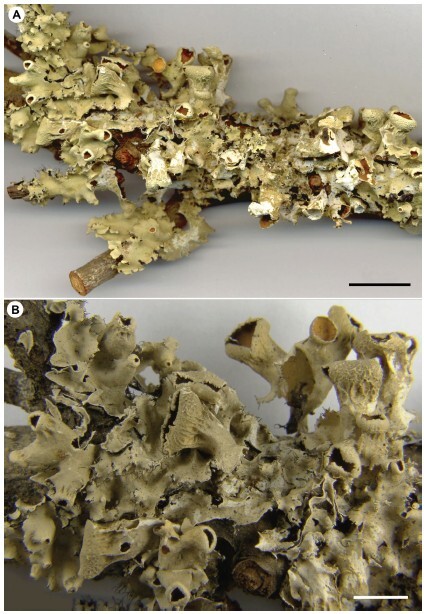
Parmotrema (Parmeliaceae, lichenized Ascomycota) with alectoronic acid: two new species, a checklist and
a preliminary worldwide key
1
Laboratório de Liquenologia/Botânica, Instituto de Biociências, Universidade
Federal de Mato Grosso do Sul, CEP 79070-900, Campo
Grande/MS, Brazil
2
Instituto de Pesquisas Ambientais, Departamento de Conservação da
Biodiversidade, Caixa Postal 3005, CEP 04301-002, São Paulo/SP,
Brazil
Submission date: 2026-06-19
Acceptance date: 2026-07-17
Online publication date: 2026-07-31
Publication date: 2026-07-31
Plant and Fungal Systematics 2026; 71(1): 250-269
KEYWORDS
ABSTRACT
A preliminary study of the Parmotrema species with alectoronic acid revealed
a list of 63 such species worldwide. Two of these are newly described here, Parmotrema
columnatum, with inflated apothecial stipes, and Parmotrema marginhiatum, with abundant
lobules, both from Brazil. A checklist with the main literature for each species and
a working key are presented together with some illustrations of types or fresh collections,
mainly from Brazil.
FUNDING
This work could not have been accomplished without the
support of the FAPESP (Fundação para o Amparo à Pesquisa
do Estado de São Paulo), CNPq (Conselho Nacional de Desenvolvimento
Científico e Tecnológico) and FUNDECT (Fundação
de Apoio ao Desenvolvimento do Ensino, Ciência e Tecnologia
do Mato Grosso do Sul).
REFERENCES (87)
1.
Adler, M. T. 1989. Two new species in Parmeliaceae (Lichenized Ascomycotina) and new records for Argentina. Mycotaxon 35(2): 399–404. https://doi.org/10.5962/p.4313....
2.
Alstrup, V., Aptroot, A., Divakar, P. D., LaGreca, S. & Tibell, L. 2010. Lichens from Tanzania and Kenya III. Macrolichens and calicioid lichens. Cryptogamie, Mycologie 31(3): 333–351.
3.
Awasthi, D. D. 1976. Lichen genus Parmelia in India I – Subgenera Parmelia and Amphigymnia. Biological Memoirs, Lichenology Series 1: 155–229.
4.
Benatti, M. N. 2005. Os gêneros Canomaculina, Parmotrema e Rimelia (Parmeliaceae, Ascomycetes) no litoral centro-sul do Estado de São Paulo. Dissertação (mestrado). Instituto de Botânica da Secretaria de Estado do Meio Ambiente. São Paulo.
5.
Benatti, M. N., Marcelli, M. P. & Elix, J. A. 2010. Two new species of the Parmotrema subrugatum group from the coast of São Paulo State, southeastern Brazil. Mycotaxon 112: 377–388. https://doi.org/10.5248/112.37....
6.
Brodo, I. M., Sharnoff, S. D. & Sharnoff, S. 2001. Lichens of North America. Yale University Press, New Haven & London.
7.
Bungartz, F. & Spielmann, A. A. 2019. The genus Parmotrema (Parmeliaceae, Lecanoromycetes) in the Galapagos Islands. Plant and Fungal Systematics 64(2): 173–231. https://doi.org/10.2478/pfs-20....
8.
Canêz, L. S. 2005. A família Parmeliaceae na localidade de Fazenda da Estrela, município de Vacaria, Rio Grande do Sul, Brasil. Dissertação (mestrado). Instituto de Botânica da Secretaria de Estado do Meio Ambiente. São Paulo. 292 p.
9.
Canêz, L. S. & Marcelli, M. P. 2006. Gêneros de Parmeliaceae (Ascomycetes liquenizados) na localidade de Fazenda da Estrela, Vacaria, Rio Grande do Sul, Brasil. Caderno de Pesquisa Série Biologia 18(3): 38–81.
10.
Chao, C., Hsü, L. & Sun, Z. 1978. Species novae parmeliae sinicae. Acta Phytotaxonomica Sinica 16(3): 95–97, + 1 plate.
11.
Chen, J-B., Wang, S-L. & Elix, J. A. 2005. Parmeliaceae (Ascomycota) lichens in China’s Mainland III. The genus Parmotrema. Mycotaxon 91: 93–113. https://doi.org/10.5962/p.4313....
12.
DePriest, P. T. & Hale, B. W. 1998. New combinations in parmelioid genera (Ascomycotina: Parmeliaceae). Mycotaxon 67: 201–206. https://doi.org/10.5962/p.4154....
13.
Dey, J. P. 1978. Fruticose and foliose lichens of the High-Mountain Areas of the Southern Appalachians. The Bryologist 81(1): 1–93. https://doi.org/10.2307/324227....
14.
Divakar, P. K. & Upreti, D. K. 2003. Additional notes and new records on the lichen genus Hypotrachyna (Parmeliaceae) from India. Mycotaxon 86: 67–76. https://doi.org/10.5962/p.4183....
15.
Divakar, P. K. & Upreti, D. K. 2005. Parmelioid Lichens in India (A Revisionary Study). Bishen Singh Mahendra Pal Singh, Dehra Dun, India.
16.
Dodge, C. W. 1959. Some lichens of Tropical Africa, III. Parmeliaceae. Annals of the Missouri Botanical Garden 46(1–2): 39–193. https://doi.org/10.2307/239456....
17.
Donha, C. G. 2005. Os gêneros Canomaculina, Parmotrema e Rimelia (Ascomycota liquenizados, Parmeliaceae) na área de proteção ambiental de Guaraqueçaba – Paraná – Brasil. Dissertação (mestrado). Universidade Federal do Paraná. Curitiba. 118 p.
18.
Egan, R. S., Harms, R. & Widhelm, T. 2005. Studies on the Lichen Parmotrema rigidum s. lat. from North and South America. The Bryologist 108(3): 402–405. https://doi.org/10.1639/0007-2....
19.
Egan, R. S., Pérez-Pérez, R. E., Nash III, T. H. 2016. Parmotrema in Mexico. Bibliotheca Lichenologica 110: 323–425.
20.
Eliasaro, S. 2001. Estudio taxonómico y florístico sobre las Parmeliaceae sensu stricto (Ascomycota Liquenizados) del Segundo Planalto del Estado de Paraná, Brasil. Buenos Aires. Tesis de Doctor (en Ciencias Biológicas). Universidad de Buenos Aires, Facultad de Ciencias Exactas y Naturales. 267 p.
21.
Eliasaro, S. & Donha, C. 2003. The genera Canomaculina and Parmotrema (Parmeliaceae, Lichenized Ascomycota) in Curitiba, Paraná State, Brazil. Revista Brasileira de Botânica 26(2): 239–247.
23.
Elix, J. A. 2007. New species in the lichen family Parmeliaceae (Ascomycota) from Australia. In: Kärnefelt, I. & Thell, A. (eds), Lichenological Contributions in Honour of David Galloway. Bibliotheca Lichenologica 95: 171–182.
24.
Elix, J. A. 2008. Additional lichen records from Australia 67. Australasian Lichenology 63: 2–9.
25.
Elix, J. A. 2014. A catalogue of standardized chromatographic data and biosynthetic relationships for lichen substances. Third edition. Published by the author. Canberra, Australia.
26.
Elix, J. A. & McCarthy, P. M. 1998. Catalogue of the Lichens of the Smaller Pacific Islands. Bibliotheca Lichenologica 70: 1–361.
27.
Elix, J. A. & Schumm, F. 2001. A new species and new records in the lichen family Parmeliaceae (Ascomycotina) from the Philippines. Mycotaxon 79: 253–260. https://doi.org/10.5962/p.4182....
28.
Elix, J. A. & Streimann, H. 1999. Additional lichen records from Australia 41. Parmeliaceae. Australasian Lichenology 45: 5–7.
29.
Elix, J. A., Bawingan, P. A. & Flores, Y. G. 2002. A new species and further new records in the lichen family Parmeliaceae (Ascomycotina) from the Philippines. Mycotaxon 81: 251–256. https://doi.org/10.5962/p.4149....
30.
Fleig, M. 1997. Os gêneros Parmotrema, Rimelia e Rimeliella (Lichenes – Ascomycotina, Parmeliaceae) no Rio Grande do Sul, Brasil. Tese (doutorado em Botânica). Instituto de Biociências, Universidade de São Paulo. São Paulo, 250 p.
31.
Fink, B. 1905. How to collect and study lichens. The Bryologist 8(2): 22–27. https://doi.org/10.2307/323790....
33.
Hale, M. E. 1958. Chemical components of type specimens in Parmelia – I. Brittonia 10: 177–180. https://doi.org/10.2307/280494....
34.
Hale, M. E. 1959. New or interesting Parmelias from North and Tropical America. The Bryologist 62: 123–132. https://doi.org/10.1639/0007-2....
35.
Hale, M. E. 1960. A revision of the South American species of Parmelia determined by Lynge. Contributions from the United States National Herbarium 36(1): 1–41.
36.
Hale, M. E. 1965. A monograph of Parmelia subgenus Amphigymnia. Contributions from the United States National Herbarium 36(5): 193–358.
37.
Hale, M. E. 1969. How to know the Lichens. The Pictured-Key Nature Series. Dubuque, Iowa: WM. C. Brown Company Publishers. Dubuque, Iowa.
38.
Hale, M. E. 1971. Two new species of Parmelia (Lichens) from North America. Phytologia 22: 92–93.
39.
Hale, M. E. 1974. New combinations in the lichen genus Parmotrema Massalongo. Phytologia 28(4): 334–339.
40.
Hale, M. E. 1977. New species in the lichen genus Parmotrema Mass. Mycotaxon 5(2): 432–448. https://doi.org/10.5962/p.4177....
41.
Hale, M. E. 1979. How to know the Lichens. The Pictured-Key Nature Series. Dubuque, Iowa: Wm. C. Brown Company Publishers. Dubuque.
42.
Hale, M. E. 1986. New species in the lichen family Parmeliaceae (Ascomycotina). Mycotaxon 25(1): 85–93. https://doi.org/10.5962/p.4170....
43.
Hale, M. E. 1990. New species of Parmotrema (Ascomycotina: Parmeliaceae) from Tropical America. Bibliotheca Lichenologica 38: 109–119.
44.
Hawksworth, D. L., Blanco, O., Divakar, P. K., Ahti, T. & Crespo, A. 2008. A first checklist of parmelioid and similar lichens in Europe and some adjacent territories, adopting revised generic circumscriptions and with indications of species distributions. The Lichenologist 40(1): 1–21. https://doi.org/10.1017/S00242....
45.
Honda, N. K., Freitas, D. S., Micheletti, A. C., Carvalho, N. C. P., Spielmann, A. A. & Canêz, L. S. 2016. Parmotrema screminiae (Parmeliaceae), a novel lichen species from Brazil with potent antimicrobial activity. Orbital: The Electronic Journal of Chemistry 8(6): 334–340. Supplement with 21 p. https://doi.org/10.17807/orbit....
46.
Hue, A. 1899. Lichenes extra-europaei a pluribus collectoribus ad Museum Parisiensi missi. Nouvelles Archives du Muséum d’Histoire Naturelle de Paris, ser. 4(1): 27–220. 6 pl.
47.
Jungbluth, P. 2006. A família Parmeliaceae (fungos liquenizados) em fragmentos de cerrados do estado de São Paulo. Dissertação (mestrado). Instituto de Botânica da Secretaria de Estado do Meio Ambiente. São Paulo. 323 p.
48.
Krempelhuber, A. von. 1878. Lichenes, collecti in republica Argentina a Doctoribus Lorentz et Hieronymus. Flora (Regensburg) 61: 433–439, 461–464, 476–480, 492–496, 516–523.
49.
Krog, H. 1991. Lichenological observations in low montane rainforest of eastern Tanzania. In: Galloway, D. J. (ed.), Tropical Lichens: Their Systematics, Conservation, and Ecology. Systematics Association Special Volume No. 43. Clarendon Press, Oxford, pp. 85–94.
50.
Krog, H. 2000. Corticolous macrolichens of low montane rainforests and moist woodlands of eastern Tanzania. Sommerfeltia 28: 1–75 https://doi.org/10.2478/som-20....
51.
Krog, H. & Swinscow, T. D. V. 1981. Parmelia subgenus Amphigymnia in East Africa. Bulletin of the British Museum (Natural History) Botany series 9(3): 143–231.
52.
Krog, H. & Swinscow, T. D. V. 1983. A new species and new combinations in Parmotrema (Parmeliaceae). The Lichenologist 15(2): 127–130. https://doi.org/10.1017/S00242....
53.
Kukwa, M., Bach, K., Sipman, H. J. M. & Flakus, A. 2012. Thirty-six species of the lichen genus Parmotrema (Lecanorales, Ascomycota) new to Bolivia. Polish Botanical Journal 57(1): 243–257.
54.
Kurokawa, S. 1979. Enumeration of species of Parmelia in Papua New Guinea. In: Kurokawa, S. (ed.), Studies on Cryptogams of Papua New Guinea. Academic Scientific Book Inc., Tokyo, pp. 125–148.
55.
Kurokawa, S. 1987. New or noteworthy species of Parmelia, subgenus Amphigymnia (Lichenes) producing alectoronic and α-collatolic acids. Bulletin of the National Science Museum Tokyo, Ser. B. 13(1): 11–15.
56.
Kurokawa, S. 1991. Japanese species and genera of the Parmeliaceae. Journal of Japanese Botany 66(3): 152–159.
57.
Kurokawa, S. & Lai, M-J. 2001. Parmelioid lichen genera and species in Taiwan. Mycotaxon 77: 225–284. https://doi.org/10.5962/p.4148....
58.
Kurokawa, S. & Mineta, M. 1973. Enumeration of Parmeliae of Ceylon. Annual Report of the Noto Marine Laboratory 13: 71–76.
59.
Kurokawa, S. & Moon, K-H. 1998. Three new species and a new combination in Parmotrema (Parmeliaceae). Bulletin of the Botanic Gardens of Toyama 3: 17–23.
60.
Louwhoff, S. H. J. J. 2001. Biogeography of Hypotrachyna, Parmotrema and allied genera (Parmeliaceae) in the Pacific Islands. In: McCarthy, P. M., Kantvilas, G. & Louwhoff, S. H. J. J. (eds), Lichenological contributions in honour of Jack Elix. Bibliotheca Lichenologica 78: 223–246.
61.
Louwhoff, S. H. J. J. & Elix, J. A. 1999. Parmotrema and allied lichen genera in Papua New Guinea. Bibliotheca Lichenologica 73: 1–152.
62.
Lynge, B. 1914. Die Flechten der ersten Regnellschen Expedition. Die gattungen Pseudoparmelia gen. nov. und Parmelia Ach. Arkiv för Botanik 13(13): 1–172.
63.
Marcelli, M. P. & Benatti, M. N. 2011. Espécies de Parmotrema (Parmeliaceae, Ascomycota) do litoral centro-sul do Estado de São Paulo V. Grupo químico alectorônico. Revista Brasileira de Botânica 34(3): 261–283.
64.
Marcelli, M. P. & Ribeiro, C. H. 2002. Twenty-one new species of Parmeliaceae (lichenized fungi) from southeastern Brazil. Mitteilungen aus dem Institut für Allgemeine Botanik Hamburg 30–32: 125–155.
65.
Marcelli, M. P., Benatti, M. N. & Elix, J. A. 2011. Two new alectoronic acid-containing Parmotrema species from the coast of São Paulo State, southeastern Brazil. Mycotaxon 115: 73–81. https://doi.org/10.5248/115.73.
66.
Marcelli, M. P., Jungbluth, P., Benatti, M. N., Spielmann, A. A., Canêz, L. S., Cunha, I. P. R. & Martins, M. F. N. 2007. Some new species and combinations of Brazilian lichenized fungi. Bibliotheca Lichenologica: 209–227.
67.
Masson, D., Magain, N. & Sérusiaux, E. 2024. Small island but great diversity: thirty six species of Parmotrema (Parmeliaceae, lichenized Ascomycota), including sixteen new species, on Réunion (Mascarenes), with additional data from the Western Indian Ocean. Phytotaxa 657(1): 1–138. https://doi.org/10.11646/phyto....
68.
Mishra, G. K. & Upreti, D. K. 2017. The lichen genus Parmotrema A. Massal. (Lecanorales, Ascomycota) from India with addition distributional records. Cryptogam Biodiversity and Assessment 2(2): 18–40. https://doi.org/10.21756/cab.v....
69.
Moore, B. J. 1968. The Macrolichen Flora of Florida. The Bryologist 71(3): 161–267. https://doi.org/10.1639/0007-2....
70.
Nash III, T. H. & Elix, J. A. 2002. Parmotrema. In: Nash III, T. H., Ryan, B. D., Gries, C. & Bungartz, F. (eds), Lichen Flora of the greater Sonoran Desert Region. Volume 1. Lichens Unlimited, Arizona State University, Tempe, Arizona, USA. pp. 318–329.
71.
Orange, A., James, P. W. & White, F. J. 2001. Microchemical methods for the identification of lichens. British Lichen Society.
72.
Park, Y. S. 1990. The Macrolichen Flora of South Korea. The Bryologist 93(2): 105–160. https://doi.org/10.2307/324361....
73.
Patwardhan, P. G. & Prabhu, A. V. 1977. Three new species of Parmeliaceae from India. The Bryologist 80: 348–350. https://doi.org/10.2307/324248....
74.
Paz-Bermúdez, G., Divakar, P. K., Etayo, J. & Araujo, E. 2023. The lichen collection from Angola and Mozambique in COI (Coimbra, Portugal). The Bryologist 126(1): 19–34. https://doi.org/10.1639/0007-2....
75.
Pooprang, T., Boonpragob, K. & Elix, J. A. 1999. New species and new records in the lichen family Parmeliaceae (Ascomycotina) from Thailand. Mycotaxon 71: 111–127. https://doi.org/10.5962/p.4150....
76.
Rambold, G., Davydov, E., Elix, J. A., Haiduk, E., Nash III, T. H., Scheidegger, Ch., Zedda, L. (eds) 2001 onwards [last visited: 2026-04-28]. LIAS light – A Database for Rapid Identification of Lichens. liaslight.lias.net/.
77.
Ribeiro, C. H. 1998. A família Parmeliaceae (Ascomycota liquenizados) em regiões montanhosas dos estados de Minas Gerais, Rio de Janeiro e São Paulo. Dissertação (mestrado em Botânica). Instituto de Biociências, Universidade de São Paulo. 194 p.
78.
Sipman, H. J. M. 2005. Mason Hale’s key to Parmotrema, revised edition: key to wide-lobed parmelioid species occurring in Tropical America (genera Canomaculina, Parmotrema, Rimelia, Rimeliella). Botanischer Garten und Botanisches Museum Berlin-Dahlem, Freie Universität Berlin. http://www.bgbm.org/sipman/key....
79.
Spielmann, A. A. & Marcelli, M. P. 2009. Parmotrema s.l. (Parmeliaceae, lichenized Ascomycota) from Serra Geral slopes in central Rio Grande do Sul State, Brazil. Hoehnea 36(4): 551–595. https://doi.org/10.1590/S2236-....
80.
Spielmann, A. A. & Marcelli, M. P. 2020. Type studies on Parmotrema (Parmeliaceae, Ascomycota) with salazinic acid. Plant and Fungal Systematics 65(2): 403–508. https://doi.org/10.35535/pfsys....
81.
Stelate, A., Del-Prado, R., Alors, D., Tahiri, H., Divakar, P. K. & Crespo, A. 2022. Resolving the phylogenetic relationship between Parmotrema crinitum and Parmotrema perlatum populations. The Lichenologist 54: 183–194. https://doi.org/10.1017/S00242....
82.
Swinscow, T. D. V. & Krog, H. 1988. Macrolichens of East Africa. British Museum (Natural History), London.
83.
Taylor, C. J. 1967. The lichens of Ohio. Part I. Foliose Lichens. The Ohio Biological Survey. Biological Notes 3: 1–151.
84.
Torres, J. M. 2018. Fungos liquenizados do Chaco Brasileiro: Florística e Taxonomia. Dissertação de Mestrado. Programa de Pós-graduação em Biologia Vegetal, Instituto de Biociências, Universidade Federal de Mato Grosso do Sul. 276 p.
85.
Vainio, E. A. 1890. Étude sur la classification naturelle et la morphologie des Lichens du Brésil. Pars prima. Acta Societatis pro Fauna et Flora Fennica 7(1): I–XXIX, 1–247. https://doi.org/10.5962/bhl.ti....
86.
Winnem, B. 1975. Parmelia subgenus Amphigymnia in Ethiopia. Norwegian Journal of Botany 22: 139–166.
87.
Zahlbruckner, A. 1926. Afrikanische Flechten (Lichenes). Botanische Jahrbücher für Systematik, Pflanzengeschichte und Pflanzengeographie 60: 468–552.
Share
RELATED ARTICLE
| eISSN: | 2657-5000 |
| ISSN: | 2544-7459 |


We process personal data collected when visiting the website. The function of obtaining information about users and their behavior is carried out by voluntarily entered information in forms and saving cookies in end devices. Data, including cookies, are used to provide services, improve the user experience and to analyze the traffic in accordance with the Privacy policy. Data are also collected and processed by Google Analytics tool (more).
You can change cookies settings in your browser. Restricted use of cookies in the browser configuration may affect some functionalities of the website.
You can change cookies settings in your browser. Restricted use of cookies in the browser configuration may affect some functionalities of the website.