ORIGINAL ARTICLE
Six new species of Sporostigma from Cuba and Colombia and confirmed placement of the genus in the Arthothelium-Pachnolepia-Snippocia-Tylophoron clade in Arthoniaceae
1
Botanischer Garten und Botanisches Museum Berlin, Freie Universität
Berlin, Königin-Luise-Straße 6–8, 14195 Berlin, Germany
2
Licenciatura en Biología, Universidad Distrital Francisco José de
Caldas, Cra. 4 No. 26B-54, Torre de Laboratorios, Herbario, Bogotá,
Colombia
3
Research School of Chemistry, Australian National University, Canberra,
Australia
4
Jardín Botánico Nacional, Carretera del Rocío km 3½, Calabazar,
19230 Habana, Cuba
Submission date: 2026-04-16
Acceptance date: 2026-06-08
Online publication date: 2026-07-31
Publication date: 2026-07-31
Plant and Fungal Systematics 2026; 71(1): 42-63
RELATED ARTICLE
KEYWORDS
ABSTRACT
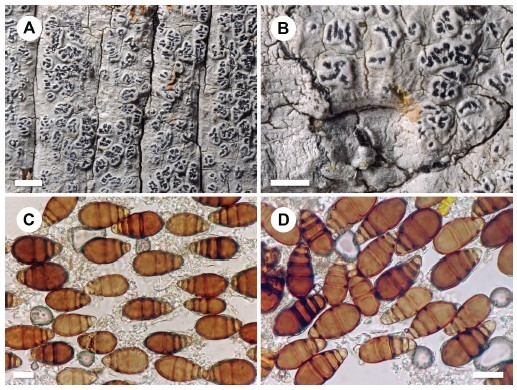
Revision of recently collected material in Cuba and Colombia revealed a surprising
diversity of Sporostigma, a hitherto monospecific genus with spot-like mazaedia and
Arthonia-type, brown ascospores, previously only known from Florida. Newly generated
molecular sequence data place the genus in the Arthoniaceae, specifically in the clade
containing the genera Arthothelium, Pachnolepia, Snippocia, and Tylophoron. Quantitative
analysis of morphological and anatomical characters led to the distinction of six new
species, which are formally described in this work: from Cuba, S. cubanum, differing from
S. melasporum in the compact thallus, the lirellate-stellate ascomata with black mazaedia
and thickened, crenulate thalline margin, and the smooth ascospores; and from Colombia,
S. hieroglyphicum, differing from S. cubanum in the immersed-erumpent mazaedia with
even, flattened margin and often with a split between mazaedium and thallus margin;
S. immersellipsoideum, differing from S. melasporum in the sharply delimited mazaedia
and the compact and smooth thallus; S. lobatum, differing from S. immersellipsoideum in
the clearly erumpent mazaedia which become elongate-lobate, the rough thallus, and the
comparatively broader ascospores with a typically papilliform proximal cell; S. pseudostromaticum,
differing from S. cubanum in the notably pseudostromatic ascomata with
branched to dissected individual mazaedia and with an even thallus margin; and S. stellatum,
differing from S. pseudostromaticum in the rough thallus, the lack of secondary divisions
of the mazaedia, and the slightly larger ascospores. This contribution is dedicated to our
esteemed colleague and friend, André Aptroot, for his numerous and invaluable contributions
to tropical crustose lichen taxonomy.
FUNDING
The workshop at the UDBC herbarium during which the material
was taxonomically assessed was supported by the DRYLICH
project “Establishing a Network of Expertise for the Lichen
Biota of the Tropical Dry Forest”, a bilateral project between
the Botanical Garden and Botanical Museum of Berlin and the
Universidad del Norte, Barranquilla, funded by the Federal Ministry
of Education and Research (Bundesministerium für Bildung
und Forschung – BMBF; Förderkennzeichen 01DN23013) and
the Ministry of Science, Technology and Innovation (MinCiencias;
Contract Number 80740-032-2023), within the program
“Promoting Scientific and Technological Cooperation Projects
with Colombia” (Förderung von Projekten der wissenschaftlich-
technologischen Zusammenarbeit mit Kolumbien).
REFERENCES (55)
1.
ANLA 2021. Autoridad Nacional de Licencias Ambientales – ANLA – AUTO N° 05369. Available from: https://www.anla.gov.co/docume... [accessed 19 Aug. 2025].
2.
Aptroot, A., Ertz, D., Silva, J. R., Grube, M. & Cáceres, M. E. S. 2015. The phylogenetic position of Coniarthonia and the transfer of Cryptothecia miniata to Myriostigma (Arthoniaceae, lichenized ascomycetes). Phytotaxa 218: 128–136. https://doi.org/10.11646/phyto....
3.
Bastidas-Parrado. D. 2022. Estudio de Impacto Ambiental para la Línea de Transmisión a 230 kV Chinú – Montería y Subestaciones Asociadas. v 1.0. https://ipt.biodiversidad.co/p....
4.
Diederich, P. & Scheidegger, C. 1996. Reichlingia leopoldii gen. et sp. nov., a new lichenicolous hyphomycete from Central Europe. Bulletin de la Société des Naturalistes Luxembourgeois 97: 3–8.
5.
Diederich, P., Lawrey, J. D. & Ertz, D. 2025. The 2025 classification and checklist of lichenicolous fungi: documenting a rapidly growing knowledge of diversity. The Bryologist 128: 765–870. https://doi.org/10.1639/0007-2....
6.
Eriksson, O. E. 1982. The families of bitunicate Ascomycetes. Opera Botanica 60: 1–209. https://doi.org/10.1111/j.1756....
7.
Ertz, D., Bungartz, F., Diederich, P. & Tibell, L. 2011. Molecular and morphological data place Blarneya in Tylophoron (Arthoniaceae). The Lichenologist 43: 345–356. https://doi.org/10.1017/S00242....
8.
Ertz, D., Sanderson, N., Łubek, A. & Kukwa, M. 2018. Two new species of Arthoniaceae from old-growth European forests, Arthonia thoriana and Inoderma sorediatum, and a new genus for Schismatomma niveum. The Lichenologist 50: 161–172. https://doi.org/10.1017/S00242....
9.
Ertz, D., Aptroot, A., Sanderson, N., Coppins, B., Van den Broeck, D. & Diederich, P. 2020. A new species of Synarthonia from Luxembourg, and a new combination in the genus Reichlingia (Arthoniaceae). The Lichenologist 52: 261–266. https://doi.org/10.1017/S00242....
10.
Falcón-Hidalgo, B. F., Bazan, S. F., Iturralde, R. B. & Borsch, T. 2020. Phylogenetic relationships and character evolution in Neotropical Phyllanthus (Phyllanthaceae), with a focus on the Cuban and Caribbean taxa. International Journal of Plant Sciences 181: 284–305. https://doi.org/10.1086/706454.
11.
Frisch, A. & Thor, G. 2010. Crypthonia, a new genus of byssoid Arthoniaceae (lichenised Ascomycota). Mycological Progress 9: 281–303. https://doi.org/10.1007/s11557....
12.
Frisch, A., Thor, G., Ertz, D. & Grube, M. 2014. The Arthonialean challenge: restructuring Arthoniaceae. Taxon 63: 727–744. https://doi.org/10.12705/634.2....
13.
Frisch, A., Ohmura, Y., Ertz, D. & Thor, G. 2015. Inoderma and related genera in Arthoniaceae with elevated white pruinose pycnidia or sporodochia. The Lichenologist 47: 233–256. https://doi.org/10.1017/S00242....
14.
Frisch, A., Moen, V. S., Grube, M. & Bendiksby, M. 2020. Integrative taxonomy confirms three species of Coniocarpon (Arthoniaceae) in Norway. MycoKeys 62: 27–51. https://doi.org/10.3897/mycoke....
15.
González Gutiérrez, P. A., Fuentes-Bazan, S., Di Vincenzo, V., Berazaín-Iturralde, R. & Borsch, T. 2023. The diversification of Caribbean Buxus in time and space: elevated speciation rates in lineages that accumulate nickel and spreading to other islands from Cuba in non-obligate ultramafic species. Annals of Botany 131: 1133–1147. https://doi.org/10.1093/aob/mc....
16.
Grube, M. 1998. Classification and phylogeny in the Arthoniales (lichenized Ascomycetes). The Bryologist 101: 377–391. https://doi.org/10.2307/324417....
17.
Grube, M. 2001a. Coniarthonia, a new genus of arthonioid lichens. The Lichenologist 33: 491–502. https://doi.org/10.1006/lich.2....
18.
Grube, M. 2001b. Sporostigma, a new calicioid genus in Arthoniales. The Lichenologist 33: 387–391. https://doi.org/10.1006/lich.2....
19.
Grube, M. 2007. Arthonia. In: Nash, T. H., Gries, III, C. & Bungartz, F. (eds), Lichen Flora of the Greater Sonoran Desert Region. Volume 3. Lichens Unlimited, Arizona State University, Tempe, pp. 39–61.
20.
Grube, M., Matzer, M. & Hafellner, J. 1995. A preliminary account of the lichenicolous Arthonia species with reddish, K+ reactive pigments. The Lichenologist 27: 25–42. https://doi.org/10.1006/lich.1....
21.
Hall, T. A. 1999. BioEdit: a user-friendly biological sequence alignment editor and analysis program for Windows 95/98/NT. Nucleic Acids Symposium Series 41: 95–98.
22.
Hall, T. A. 2011. BioEdit: an important software for molecular biology. GERF Bulletin of Bioscience 2: 60–61.
23.
Henssen, A. & Jahns, H. M. 1973 (“1974”). Lichenes – Eine Einführung in die Flechtenkunde. Thieme, Stuttgart.
24.
ISA INTERCOLOMBIA E.S.P. S.A., Andina de Energía SAS. 2024. Biodiversidad asociada al Estudio de Impacto Ambiental del proyecto: Interconexión Cuestecitas – Copey – Fundación 500/220 mil voltios. ISA INTERCOLOMBIA S.A E.S.P. Occurrence dataset. https://doi.org/10.15472/dak1o....
25.
ISA INTERCOLOMBIA E.S.P. S.A., Andina de Energía SAS. 2025. Biodiversidad asociada al Estudio de Impacto Ambiental del proyecto: Línea de transmisión Cerromatoso – Chinú – Copey 500 kV. Version 2.0. ISA INTERCOLOMBIA S.A E.S.P. Occurrence dataset. https://doi.org/10.15472/jqnek....
26.
Iturralde, R. B. & Rodríguez, R. R. 2018. Las exploraciones botánicas en Cuba. Revista del Jardín Botánico Nacional 39: 125–127.
27.
Katoh, K. & Standley, D. M. 2013. MAFFT multiple sequence alignment software version 7: improvements in performance and usability. Molecular Biology and Evolution 30: 772–780. https://doi.org/10.1093/molbev....
28.
Kraichak, E., Lücking, R., Aptroot, A., Beck, A., Dornes, P., John, V., Lendemer, J. C., Nelsen, M. P., Neuwirth, G., Nutakki, A. & Parnmen, S. 2015. Hidden diversity in the morphologically variable script lichen (Graphis scripta) complex (Ascomycota, Ostropales, Graphidaceae). Organisms Diversity & Evolution 15: 447–458. https://doi.org/10.1007/s13127....
29.
Larrota-Estupiñan, F. 2018. Propuesta Metodológica para la Caracterización de Especies en Veda de Hábito Epífito, Terrestre y/o Rupícola. Thesis, Universidad Militar Nueva Granada, Bogotá.
30.
Lücking, R. 1995. Additions and corrections to the foliicolous lichen flora of Costa Rica. The family Arthoniaceae, with notes on the genus Stirtonia. The Lichenologist 27: 127–153. https://doi.org/10.1006/lich.1....
31.
Lücking, R., Hodkinson, B. P. & Leavitt, S. D. 2017. The 2016 classification of lichenized fungi in the Ascomycota and Basidiomycota – Approaching one thousand genera. The Bryologist 119: 361–416. https://doi.org/10.1639/0007-2....
32.
Lücking, R., Moncada, B., Sipman, H. J. M., Sobreira, P. N. B., Viñas-Portilla, C., Gutíerrez, J. & Flynn, T. W. 2020. Saxiloba, a new genus of placodioid lichens from the Caribbean and Hawaii shakes up the Porinaceae tree (lichenized Ascomycota, Gyalectales). Plant and Fungal Systematics 65: 577–585. https://doi.org/10.35535/pfsys....
33.
Lumbsch, H. T., Lücking, R. & Tibell, L. 2009. Molecular data place Tylophoron as an additional calicioid genus in the Arthoniales (Ascomycota). Bibliotheca Lichenologica 99: 285–296.
34.
Mangold, A., Martín, M. P., Lücking, R. & Lumbsch, H. T. 2008. Molecular phylogeny suggests synonymy of Thelotremataceae within Graphidaceae (Ascomycota: Ostropales). Taxon 57: 476–486. https://doi.org/10.2307/250660....
35.
Matzer, M. 1996. Lichenicolous Ascomycetes with fissitunicate asci on foliicolous lichens. Mycological Papers 171: 1–202.
36.
McCune, B. & Mefford, M. J. 1999. PC-ORD. Multivariate Analysis of Ecological Data, Vers. 7. User’s Guide.
37.
Moncada, B., Coca, L. F., Díaz-Escandón, D., Jaramillo-Ciro, M. Simijaca-Salcedo, D., Soto-Medina, E. & Lücking, R. 2022. Biodiversity, ecogeography and importance of Colombian lichens. In: de Almeida, R. F., Lücking, R., Vasco-Palacios, A. M., Gaya, E. & Diazgranados, M. (eds), Catalogue of Fungi of Colombia. Kew Publishing, Royal Botanic Gardens, Kew, pp. 77–90.
38.
Orange, A., James, P. W. & White, F. J. 2010. Microchemical Methods for the Identification of Lichens. Second Edition. British Lichen Society, London.
39.
Perlmutter, G. B., Miranda-González, R. & Bungartz, F. 2023. Placement of Arthonia rubrocincta in Coniocarpon (lichenized Ascomycota: Arthoniaceae), with an extended range for the species in southeastern North America and the Caribbean. Phytotaxa 589: 278–282. https://doi.org/10.11646/phyto....
40.
Rankin-Rodríguez, R. & Greuter, W. 2016. Conocer para conservar – la exploración botánica y la Flora de la República de Cuba. In: Fuentes Bazan, S. & Grotz, K. (eds), Islas del Tesoro Verde. Descubrimientos Botánicos en el Caribe. Botanischer Garten und Botanisches Museum Berlin.
41.
SIB (2023) Interconexión Cuestecita – Copey – Fundación 500/220 mil voltios. Available from: https://ipt.biodiversidad.co/p... [accessed 19 Aug. 2025].
42.
Sipman, H. J. M. & Aguirre-C., J. 2016. Líquenes. In: Bernal, R., Gradstein, S. R. & Celis, M. (eds), Catálogo de Plantas y Líquenes de Colombia. Volumen 1. Universidad Nacional de Colombia, Facultad de Ciencias, Instituto de Ciencias Naturales, Bogotá, pp. 159–281.
43.
Soto Medina, E., Díaz-Escandón, D. & Montaño, J. 2021. Biogeografía y riqueza de los líquenes de Colombia. Revista de la Academia Colombiana de Ciencias Exactas, Físicas y Naturales 45: 122–135. https://doi.org/10.18257/racce....
44.
Stamatakis, A. 2015 Using RAxML to Infer Phylogenies. Unit 6.14, Current Protocols in Bioinformatics. New York: John Wiley.
45.
Sundin, R. 1999. Phylogenetic and Taxonomic Studies within Arthonia Ach. (Ascomycetes, Arthoniales). Stockholm University, Stockholm.
46.
Sundin, R. & Tehler, A. 1998. Phylogenetic studies of the genus Arthonia. The Lichenologist 30: 381–413. https://doi.org/10.1006/lich.1....
47.
Thiyagaraja, V., Lücking, R., Ertz, D., Wanasinghe, D. N., Karunarathna, S. C., Camporesi, E. & Hyde, K. D. 2020. Evolution of non-lichenized, saprotrophic species of Arthonia (Ascomycota, Arthoniales) and resurrection of Naevia, with notes on Mycoporum. Fungal Diversity 102: 205–224. https://doi.org/10.1007/s13225....
48.
Tibell, L. 1982. Caliciales of Costa Rica. The Lichenologist 14: 219–254. https://doi.org/10.1017/S00242....
50.
Van Den Broeck, D. & Ertz, D., 2016. Cryptophaea, a new genus of byssoid Arthoniaceae (lichenized Ascomycota) and its phylogenetic position. Phytotaxa 261: 168–176. https://doi.org/10.11646/phyto....
51.
Van den Broeck, D., Frisch, A., Razafindrahaja, T., van de Vijver, B. & Ertz, D. 2018. Phylogenetic position of Synarthonia (lichenized Ascomycota, Arthoniaceae), with the description of six new species. Plant Ecology and Evolution 151: 327–351. https://doi.org/10.5091/plecev....
52.
Vilgalys, R. & Hester, M. 1990. Rapid genetic identification and mapping of enzymatically amplified ribosomal DNA from several Cryptococcus species. Journal of Bacteriology 172: 4238–4246. https://doi.org/10.1128/jb.172....
55.
Zoller, S., Scheidegger, C. & Sperisen, C. 1999. PCR primers for the amplification of mitochondrial small subunit ribosomal DNA of lichen-forming ascomycetes. The Lichenologist 31: 511–516. https://doi.org/10.1006/lich.1....
| eISSN: | 2657-5000 |
| ISSN: | 2544-7459 |


We process personal data collected when visiting the website. The function of obtaining information about users and their behavior is carried out by voluntarily entered information in forms and saving cookies in end devices. Data, including cookies, are used to provide services, improve the user experience and to analyze the traffic in accordance with the Privacy policy. Data are also collected and processed by Google Analytics tool (more).
You can change cookies settings in your browser. Restricted use of cookies in the browser configuration may affect some functionalities of the website.
You can change cookies settings in your browser. Restricted use of cookies in the browser configuration may affect some functionalities of the website.