ORIGINAL ARTICLE
First European record of Sticta arenosella and new Central
European records of Sticta fuliginoides
1
Institute of Integrative Biology, ETH Zürich, Universitätsstrasse 16,
Zürich 8092, Switzerland
2
Else-Züblin-Strasse 101, Winterthur 8404, Switzerland
Submission date: 2025-08-02
Acceptance date: 2025-10-20
Online publication date: 2025-12-09
Publication date: 2025-12-09
Plant and Fungal Systematics 2025; 70(2): 75-84
KEYWORDS
ABSTRACT
The genus Sticta has recently undergone significant taxonomic revisions in Europe,
yet central regions such as Switzerland were not included in those revisions. To assess the
diversity of the species complex Sticta fuliginosa in Switzerland, we used an integrative
taxonomic approach combining morphological and genetic analyses. We sampled both the
well-known localities, as well as newly discovered localities along the Doubs River. Our
results showed that S. fuliginosa is presently absent from Switzerland. Instead, we confirmed
the presence of S. fuliginoides, and reported the first occurrence of S. arenosella, a species
previously known only from North and South America. Morphological, phylogenetic, and
haplotype network analyses confirmed that the Swiss specimen identified as S. arenosella is
morphologically and genetically indistinguishable from its holotype. Additionally, we also
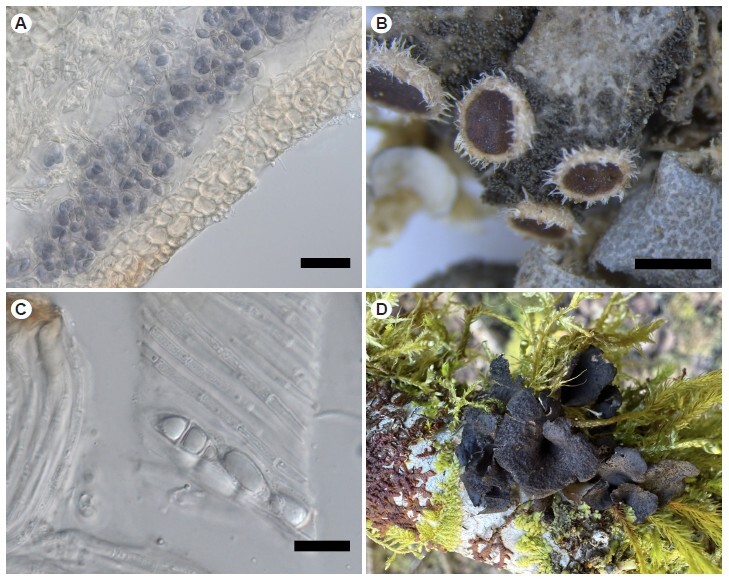
documented the presence of apothecia on S. fuliginoides for the first time. This expands
the known phenotypic variation in this species and allows for a more complete taxonomic
description. Finally, we provide a taxonomic key for the Central European species of Sticta
to facilitate future research and monitoring.
FUNDING
The Legat “Eduard August Rübel”
supported the study financially as part of the project “Seltene
Makroflechten entlang dem Doubs”.
REFERENCES (42)
1.
Arsenault, A. & Goward, T. 2016. Macrolichen diversity as an indicator of stand age and ecosystem resilience along a precipitation gradient in humid forests of inland British Columbia, Canada. Ecological Indicators 69: 730–738. https://doi.org/10.1016/j.ecol....
2.
Barcenas-Peña, A., Divakar, P. K., Crespo, A., Nuñez-Zapata, J., Lumbsch, H. T. & Grewe, F. 2023. Reference-Based Restriction-Site-Associated DNA sequencing data are useful for species delineation in a recently diverged asexually reproducing species complex (Parmeliaceae, Ascomycota). Journal of Fungi 9: 1180. https://doi.org/10.3390/jof912....
3.
Boluda, C. G., Rico, V. J., Divakar, P. K., Nadyeina, O., Myllys, L., McMullin, R. T., Zamora, J. C., Scheidegger, C. & Hawksworth, D. L. 2018. Evaluating methodologies for species delimitation: the mismatch between phenotypes and genotypes in lichenized fungi (Bryoria sect. implexae, Parmeliaceae). Persoonia 42: 75–100. https://doi.org/10.3767/persoo....
4.
Capella-Gutiérrez, S., Silla-Martínez, J. M. & Gabaldón, T. 2009. trimAl: a tool for automated alignment trimming in large-scale phylogenetic analyses. Bioinformatics (Oxford, England) 25: 1972–1973. https://doi.org/10.1093/bioinf....
6.
De Paz, G. A., Cubas, P., Crespo, A., Elix, J. A. & Lumbsch, H. T. 2012. Transoceanic Dispersal and Subsequent Diversification on Separate Continents Shaped Diversity of the Xanthoparmelia pulla Group (Ascomycota). PLOS ONE 7: 1–12. https://doi.org/10.1371/journa....
7.
Di Meglio, J. R. D. & Goward, T. 2023. Resolving the Sticta fuliginosa Morphodeme (Lichenized Ascomycota: Peltigeraceae) in Northwestern North America. The Bryologist 126: 90–110. https://doi.org/10.1639/0007-2....
8.
Ekman, S., Tønsberg, T. & Jørgensen, P. M. 2019. The Sticta fuliginosa group in Norway and Sweden. Graphis Scripta 31: 23–33.
9.
Galloway, D. J. 1994. Studies on the lichen genus Sticta (Schreber) Ach.: II. Typification of taxa from Swartz’s Prodromus of 1788. Bulletin of the Natural History Museum. Botany series 24: 35–48.
10.
Gardes, M. & Bruns, T. D. 1993. ITS primers with enhanced specificity for basidiomycetes – application to the identification of mycorrhizae and rusts. Molecular Ecology 2: 113–118. https://doi.org/10.1111/j.1365....
11.
Grewe, F., Lagostina, E., Wu, H., Printzen, C. & Lumbsch, H. T. 2018. Population genomic analyses of RAD sequences resolves the phylogenetic relationship of the lichen-forming fungal species Usnea antarctica and Usnea aurantiacoatra. MycoKeys 43: 91–113. https://doi.org/10.3897/mycoke....
12.
Katoh, K. & Standley, D. M. 2013. (MAFFT) multiple sequence alignment software version 7: improvements in performance and usability. Molecular Biology and Evolution 30: 772–780. https://doi.org/10.1093/molbev....
13.
Leavitt, S. D., Kirika, P. M., Amo de Paz, G., Huang, J.-P., Hur, J.-S., Elix, J. A., Grewe, F., Divakar, P. K. & Lumbsch, H. T. 2018. Assessing phylogeny and historical biogeography of the largest genus of lichen-forming fungi, Xanthoparmelia (Parmeliaceae, Ascomycota). The Lichenologist 50: 299–312. https://doi.org/10.1017/S00242....
14.
Lebreton, E., Ertz, D., Lücking, R., Aptroot, A., Carriconde, F., Ah-Peng, C., Huang, J.-P., Chen, K.-H., Stenger, P.-L., da Silva Cáceres, M. E., van den Boom, P., Sérusiaux, E. & Magain, N. 2025. Global phylogeny of the family Gomphillaceae (Ascomycota, Graphidales) sheds light on the origin, diversification and endemism in foliicolous lineages. IMA Fungus 16: e144194. https://doi.org/10.3897/imafun....
15.
Lewis, L. R., Rozzi, R. & Goffinet, B. 2014. Direct long-distance dispersal shapes a New World amphitropical disjunction in the dispersal-limited dung moss Tetraplodon (Bryopsida: Splachnaceae). Journal of Biogeography 41: 2385–2395. https://doi.org/10.1111/jbi.12....
16.
Liška, J., Palice, Z. & Slavíková, Š. 2008. Checklist and red list of lichens of the Czech Republic. Preslia 80: 151–182.
17.
Lücking, R., Hodkinson, B. P. & Leavitt, S. D. 2017. The 2016 classification of lichenized fungi in the Ascomycota and Basidiomycota – Approaching one thousand genera. The Bryologist 119: 361–416. https://doi.org/10.1639/0007-2....
18.
Lücking, R., Leavitt, S. D. & Hawksworth, D. L. 2021. Species in lichen-forming fungi: balancing between conceptual and practical considerations, and between phenotype and phylogenomics. Fungal Diversity 109: 99–154. https://doi.org/10.1007/s13225....
19.
Magain, N. & Sérusiaux, E. 2015. Dismantling the treasured flagship lichen Sticta fuliginosa (Peltigerales) into four species in Western Europe. Mycological Progress 14(10): 97. https://doi.org/10.1007/s11557....
20.
Minh, B. Q., Schmidt, H. A., Chernomor, O., Schrempf, D., Woodhams, M. D., von Haeseler, A. & Lanfear, R. 2020. IQ-TREE 2: New Models and Efficient Methods for Phylogenetic Inference in the Genomic Era. Molecular Biology and Evolution 37: 1530–1534. https://doi.org/10.1093/molbev....
21.
Moncada, B., Lückig, R. & Coca, L. F. 2013. Six new apotheciate species of Sticta (lichenized Ascomycota: Lobariaceae) from the Colombian Andes. The Lichenologist 45: 635–656. https://doi.org/10.1017/S00242....
22.
Moncada, B., Aguirre, J. & Lücking, R. 2014a. Ecogeography of the genus Sticta (lichenized Ascomycota: Lobariaceae) in Colombia. Revista de Biología Tropical 62: 257–272. https://doi.org/10.15517/rbt.v....
23.
Moncada, B., Lücking, R. & Suárez, A. 2014b. Molecular phylogeny of the genus Sticta (lichenized Ascomycota: Lobariaceae) in Colombia. Fungal Diversity 64: 205–231. https://doi.org/10.1007/s13225....
24.
Moncada, B., Lücking, R. K. & Lumbsch, H. T. 2020. Rewriting the evolutionary history of the lichen genus Sticta (Ascomycota: Peltigeraceae subfam. Lobarioideae) in the Hawaiian islands. Plant and Fungal Systematics 65: 95–119. https://doi.org/10.35535/pfsys....
25.
Moncalvo, J.-M. & Buchanan, P. K. 2008. Molecular evidence for long distance dispersal across the southern hemisphere in the Ganoderma applanatum-australe species complex (Basidiomycota). Mycological Research 112: 425–436. https://doi.org/10.1016/j.mycr....
26.
Nascimbene, J., Nimis, P. L. & Ravera S. 2013. Evaluating the conservation status of epiphytic lichens of Italy: A red list. Plant Biosystems – An International Journal Dealing with all Aspects of Plant Biology 147: 898–904. https://doi.org/10.1080/112635....
28.
Ossowska, E. A., Schiefelbein, U. & Kukwa, M. 2024. First records of Sticta arenosella and S. cellulosa from South America based on molecular and morphological data. Plant and Fungal Systematics 69: 77–84. https://doi.org/10.35535/pfsys....
29.
Otálora, M. A. G., Martínez, I., Aragón, G. & Molina, M. C. 2010. Phylogeography and divergence date estimates of a lichen species complex with a disjunct distribution pattern. American Journal of Botany 97: 216–223. https://doi.org/10.3732/ajb.09....
30.
Paradis, E. 2010. pegas: an R package for population genetics with an integrated–modular approach. Bioinformatics 26: 419–420. https://doi.org/10.1093/bioinf....
31.
R Core Team 2021. R: A Language and Environment for Statistical Computing. R Foundation for Statistical Computing, Vienna, Austria.
32.
Rambaut, A. 2018. FigTree – tree.bio.ed.ac.uk. https://tree.bio.ed.ac.uk/soft... [accessed on 30 Mar. 2025].
33.
Sanderson, N. 2016. The field identification of the species within Sticta fuliginosa s.lat. in Britain. British Lichen Society Bulletin 119: 2–14.
34.
Scheidegger, C. & Clerc, P. 2002. Rote Liste der gefährdeten Arten der Schweiz: Baum- und erdbewohnende Flechten. Hrsg. Bundesamt für Umwelt, Wald und Landschaft BUWAL, Bern, und Eidgenössische Forschungsanstalt WSL, Birmensdorf, und Conservatoire et Jardin botaniques de la Ville de Genève CJBG. BUWAL-Reihe Vollzug Umwelt.
35.
Sérusiaux, E., Villarreal A., J. C., Wheeler, T. & Goffinet, B. 2011. Recent origin, active speciation and dispersal for the lichen genus Nephroma (Peltigerales) in Macaronesia. Journal of Biogeography 38: 1138–1151. https://doi.org/10.1111/j.1365....
36.
Simon, A., Goward, T., Di Meglio, J., Dillman, K., Spribille, T. & Goffinet, B. 2018. Sticta torii sp. nov., a remarkable lichen of high conservation priority from northwestern North America. Graphis Scripta 30: 105–114.
37.
Stofer, S., Scheidegger, C., Clerc, P., Dietrich, M., Frei, M., Groner, U., Keller, C., Meraner, I., Roth, I., Vust, M. & Zimmermann, E. 2019. SwissLichens – Webatlas der Flechten der Schweiz (Version 3). www.swisslichens.ch [accessed on 8 Apr. 2025].
38.
Vilgalys, R. & Hester, M. 1990. Rapid genetic identification and mapping of enzymatically amplified ribosomal DNA from several Cryptococcus species. Journal of Bacteriology 172: 4238–4246. https://doi.org/10.1128/jb.172....
39.
Weigelt, P., Daniel Kissling, W., Kisel, Y., Fritz, S. A., Karger, D. N., Kessler, M., Lehtonen, S., Svenning, J.-C. & Kreft, H. 2015. Global patterns and drivers of phylogenetic structure in island floras. Scientific Reports 5: 12213. https://doi.org/10.1038/srep12....
40.
White, T. J., Bruns, T., Lee S. & Taylor, J. 1990. Amplification and direct sequencing of fungal ribosomal RNA genes for phylogenetics. In: Innis, M. A., Gelfand, D. H., Sninsky, J. J., White, J. W. (eds), PCR Protocols. A Guide to Molecular Methods and Applications. Acad. Press, pp. 315–322. https://doi.org/10.1016/B978-0....
41.
Wirth, V., Hauck, M., von Brackel, W., Cezanne, R., de Bruyn, U., Dürhammer, O., Eichler, M., Gnüchtel, A., John, V., Litterski, B., Otte, V., Schiefelbein, U., Scholz, P., Schultz, M., Stordeur, R., Feuerer, T. & Heinrich, D. 2011. Rote Liste und Artenverzeichnis der Flechten und flechtenbewohnenden Pilze Deutschlands. Naturschutz und Biologische Vielfalt 70: 7–122.
42.
Zoller, S., Scheidegger, C. & Sperisen, C. 1999. PCR primers for the amplification of mitochondrial small subunit ribosomal DNA of lichen-forming ascomycetes. The Lichenologist 31: 511–516. https://doi.org/10.1006/lich.1....
Share
RELATED ARTICLE
| eISSN: | 2657-5000 |
| ISSN: | 2544-7459 |


We process personal data collected when visiting the website. The function of obtaining information about users and their behavior is carried out by voluntarily entered information in forms and saving cookies in end devices. Data, including cookies, are used to provide services, improve the user experience and to analyze the traffic in accordance with the Privacy policy. Data are also collected and processed by Google Analytics tool (more).
You can change cookies settings in your browser. Restricted use of cookies in the browser configuration may affect some functionalities of the website.
You can change cookies settings in your browser. Restricted use of cookies in the browser configuration may affect some functionalities of the website.