ORIGINAL ARTICLE
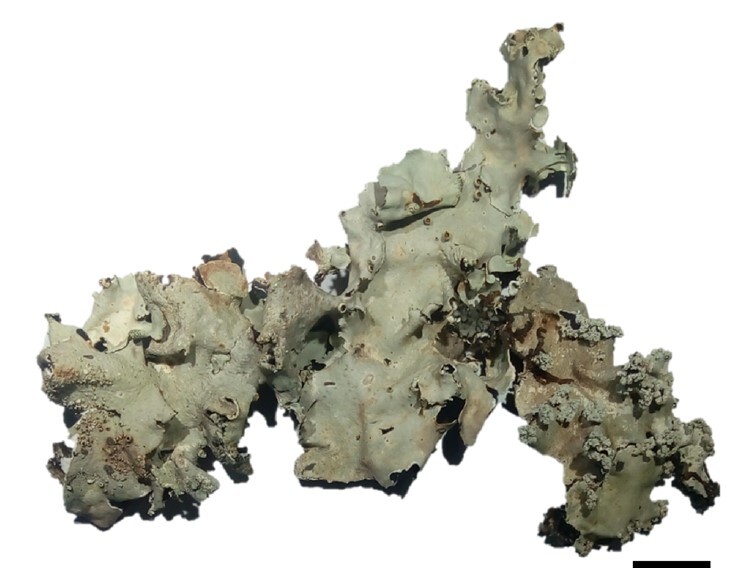
Expanding the occurrence of Parmotrema enteroxanthum (Parmeliaceae, lichenized Ascomycota) in South America: first record from Brazil, and notes on distribution and conservation assessment
1
Universidade Estadual da Região Tocantina do Maranhão, Centro de Ciências Exatas, Naturais e Tecnológicas, Imperatriz/MA, Brazil
2
Universidade Estadual Paulista “Júlio de Mesquita Filho”, Instituto de Biociências de Botucatu, Departamento de Biodiversidade, Botucatu/SP, Brazil
3
Universidade Federal do Maranhão, Departamento de Saúde e Tecnologias, Imperatriz/MA, Brazil
These authors had equal contribution to this work
Submission date: 2025-10-07
Acceptance date: 2025-12-22
Online publication date: 2025-12-31
Publication date: 2025-12-31
Plant and Fungal Systematics 2025; 70(2): 85-90
KEYWORDS
ABSTRACT
Parmotrema enteroxanthum is a restricted distribution foliose lichen, easily recognized by its yellow medulla and salazinic acid content. Previously known only from Venezuela, Colombia, and Bolivia, its distribution in South America remains poorly understood. This study documents the first record of the species in Brazil, with notes on ecology and conservation. Field collections were conducted from Cerrado areas in the state of Maranhão, northeastern Brazil. Morphological and chemical analyses were performed using microscopy, spot tests, and thin-layer chromatography. Distribution data were compiled from GBIF, and conservation status was preliminarily assessed using GeoCat, based on IUCN criteria. Parmotrema enteroxanthum was recorded in cerradão vegetation, extending its range into Brazil and the Cerrado domain (Brazilian Savanna). The species occurs in seasonally dry and rainforest habitats (open/ exposed microhabitats) in South America. Geospatial analysis indicated a wide Extent of Occurrence (~3.6 million km2), but a very restricted Area of Occupancy (16 km2), suggesting a fragmented distribution. According to IUCN criteria, the species may be considered potentially Endangered (EN) due to its low number of localities and ongoing habitat loss. This finding underscores the Cerrado as both a center of lichen diversity and a highly threatened biome.
FUNDING
The authors thank FAPEMA (Fundação de Amparo à Pesquisa e ao Desenvolvimento Científico e Tecnológico do Maranhão, Brazil) for the Master scholarship granted (Process BM-93561/25) to the first author, TSD. IPRCD thanks UEMASUL (Universidade Estadual da Região Tocantina do Maranhão) productivity fellowship (object of the edital n° 014/2022-CPG/PROPGI/UEMASUL), for the financial support granted.
REFERENCES (36)
1.
Aguirre-C, J. & Rangel-Ch., J. O. 2007. Amenazas a la conservación de las especies de musgos y líquenes en Colombia – una aproximación inicial. Caldasia 29: 235–262.
2.
Alencar, A., Shimbo, J. Z., Lenti, F., Marques, C. B., Zimbres, B., Rosa, M., Arruda, V., Castro, I., Ribeiro, J. P. F. M., Varela, V., Alencar, I., Piontekowski, V., Ribeiro, V., Bustamante, M. M. C., Sano, E. & Barroso, M. 2020. Mapping Three Decades of Changes in the Brazilian Savanna Native Vegetation Using Landsat Data Processed in the Google Earth Engine Platform. Remote Sensing 12(6): 1–23. https://doi.org/10.3390/rs1206....
3.
Allen, J. L. & Lendemer, J. C. 2016. Quantifying the impacts of sea-level rise on coastal biodiversity: A case study on lichens in the mid-Atlantic Coast of eastern North America. Biological Conservation 202: 119–126. https://doi.org/10.1016/j.bioc....
4.
Aptroot, A., Feuerstein, S. C., Cunha-Dias, I. P. R., Nunes, A. R. L., Honorato, M. E. & Cáceres, M. E. S. 2017. New lichens pecies and lichen reports from Amazon forest remnants and Cerrado vegetation in the Tocantina region, northern Brazil. The Bryologist 120: 320–328. https://doi.org/10.1639/0007-2....
5.
Aptroot, A., Cáceres, M. E. S., Santos, L. A., Benatti, M. N., Canêz, L., Dal Forno, M., Feuerstein, S. C., Fraga Junior, C. A. V., Gerlach, A. C. L., Gumboski, E. L., Jungbluth, P., Käffer, M. I., Kalb, K., Koch, N. M., Lücking, R., Torres, J. M. & Spielmann, A. A. 2025. The Brazilian lichen checklist: 4,828 accepted taxa constitute a country-level world record. The Bryologist 128(2): 96–423. https://doi.org/10.1639/0007-2....
6.
Bachman, S., Moat, J., Hill, A. W., de la Torre, J. & Scott, B. 2011. Supporting Red List threat assessments with GeoCAT: geospatial conservation assessment tool. ZooKeys 150: 117–126. https://doi.org/10.3897/zookey....
7.
Benatti, M. N. & Marcelli, M. P. 2007. Gêneros de fungos liquenizados dos manguezais do sul-sudeste do Brasil, com enfoque no manguezal do Rio Itanhaém, estado de São Paulo. Acta Botanica Brasilica 21: 863–878.
8.
Blanco, O., Crespo, A., Ree, R. H. & Lumbsch, H. T. 2006. Major clades of parmeliold lichens (Parmeliaceae, Ascomycota) and the evolution of their morphological and chemical diversity. Molecular Phylogenetics and Evolution 39: 52–69.
9.
Bungartz, F. 2002. Recipes and other techniques. In: Nash III, T. H., Ryan, B. D., Gries, C. & Bungartz, F. (eds), Lichen flora of the Greater Sonoran Desert Region. Volume 1. Lichens Unlimited. Tempe, pp. 49–52.
10.
Canêz, L. S. & Marcelli, M. P. 2006. Gêneros de Parmeliaceae (Ascomycetes Liquenizados) na Localidade de Fazenda da Estrela, Vacaria, Rio Grande do Sul, Brasil. Caderno de Pesquisa (Série Biológica) 18: 41–95.
11.
Ciecoski, F. A. R., Barbosa, F. R., Marcelli, M. P. & Hora, B. R. 2024. Some species of Parmotrema (Parmeliaceae) from the Brazilian Amazon with salazinic acid. Hoehnea 51: 1–20. https://doi.org/10.1590/2236-8....
12.
Correia-Filho, F. L. 2011. Relatório diagnóstico do município de São João do Paraíso. Projeto Cadastro de Fontes de Abastecimento por Água Subterrânea, Estado do Maranhão. Available at: https://rigeo.sgb.gov.br/bitst....
13.
Crespo, A., Kauff, F., Divakar, P. K., del Prado, R., Pérez-Ortega, S., de Paz, G. A., Ferencova, Z., Blanco, O., Roca Valiente, B., Núñez-Zapata, J. Cubas, P., Arguello, A., Elix, J., Esslinger, T. L., Hawksworth, D. L., Millanes, A., Molina, M. C., Wedin, M., Ahti, T., Aptroot, A., Barreno, E., Bungartz, F., Calvelo, S., Candan, M., Cole, M., Ertz, D., Goffinet, B., Lindblom, L., Lücking, R., Lutzoni, F., Mattsson, J. A., Messuti, M. I., Miadlikowska, J., Piercey-Normore, M., Rico, V. J., Sipman, H. J. M., Schmitt, I., Spribille, T., Thell, A., Thor, G., Upreti, D. K. & Lumbsch, H. T. 2010. Phylogenetic generic classification of parmelioid lichens (Parmeliaceae, Ascomycota) based on molecular, morphological and chemical evidence. Taxon 59: 1735–1753. https://doi.org/10.1002/tax.59....
14.
Cunha-Dias, I. P. R., Santos, J. S., Dutra, T. S., Santos, A. J. M. & Nascimento, G. M. 2025. A new species of Parmotrema (Parmeliaceae, lichenized Ascomycota) from Cerrado vegetation in the state of Maranhão, Brazil. Rodriguésia 76: e01042024. https://doi.org/10.1590/2175-7....
15.
Drechsler-Santos, E. R., Martins-Cunha, K., Kossmann, T., Alves-Silva, G., Bittencourt, F., Cardoso, D., Trierveiler-Pereira, L., Cabral, T. S., Góes-Neto, A., Calaça, F. J. S., Werner, D., Verdi, M., Rocha, F. L., Fernandez, E. P., Martinelli, G., Canez, L., Spielmann, A., Urruth, L. M., Carbonell-Santos, L., Menolli Jr, N., Barreto, R. W., Wiederhecker, S., Canteiro, C., Mueller, G. M. & Costa-Rezende, D. H. 2025. Brazil as a global player in fungal conservation: A rapid shift from neglect to action. Perspectives in Ecology and Conservation 23: 246–254. https://doi.org/10.1016/j.peco....
16.
Elix, J. A. 2014. A catalogue of standardized chromatographic data and biosynthetic relationships for lichen substances. Third Edition: Canberra, 323 p.
17.
Flakus, A., Oset, M., Rykaczewski, M., Schiefelbein, U. & Kukwa, M. 2016. Contribution to the knowledge of the lichen biota of Bolivia. 8. Polish Botanical Journal 61: 107–126. https://doi.org/10.1515/pbj-20....
19.
Haddad, N. M., Brudvig L. A., Clobert, J., Davies, K. F., Gonzalez, A., Holt, E. D., Lovejoy, T. E., Sexton, J. O., Austin, M. P., Collins, C. D., Cook, W. M., Damschen, E. I., Ewers, R. M., Foster, B. L., Jenkins, C. N., King, A. J., Laurance, W. F., Levey, D. J., Margules, C. R., Melbourne, C. A., Nicholls, A. O., Orrock, J. L., Song, D.-X. & Townshend, J. R. 2015. Habitat fragmentation and its lasting impact on Earth’s ecosystems. Science Advances 1(2): e1500052. https://doi.org/10.1126/sciadv....
20.
Hale, M. E. 1977. New species in the lichen genus Parmotrema Mass. Mycotaxon 5: 432–448.
21.
Hale, M. E. 1979. How to know the lichens. 2 ed. The Pictured-Key Nature Series, Dubuque. 246 p.
22.
Hüneck, S. & Yoshimura, I. 1996. Identification of lichen substances. Springer, Berlin, 493 p.
23.
IUCN. 2024. Guidelines for Using the IUCN Red List Categories and Criteria, version 16. Available at: https://cmsdocs.s3.amazonaws.c... [accessed on 25 May 2025].
24.
Klink, C. A. & Machado, R. B. 2005. A conservação do Cerrado brasileiro. Megadiversidade 1(1): 148–155.
25.
Lücking, R., Hodkinson, B. P. & Leavitt, S. D. 2017. The 2016 classification of lichenized fungi in the Ascomycota and Basidiomycota – Approaching one thousand genera. The Bryologist 119(4): 361–416. https://doi.org/10.1639/0007-2....
26.
Myers, N., Mittermeier, R. A., Mittermeier, C.G., Fonseca, G.A.B. & Kent, J. 2000. Biodiversity hotspots for conservation priorities. Nature 403: 853–858. https://doi.org/10.1038/350025....
27.
Nascimento, G. M., Dutra, T. S., & Cunha-Dias, I. P. R. 2025. A new species of Parmotrema (Parmeliaceae, lichenized Ascomycota) with lecanoric acid from the Cerrado of Maranhão State, Northeast Brazil. The Bryologist 128(3): 506–513. https://doi.org/10.1639/0007-2....
28.
Orange, A., James, P. W. & White, F. J. 2010. Microchemical methods for the identification of lichens. Londres: British Lichen Society 101p.
29.
QGIS.org. 2023. QGIS Geographic Information System (v. 3.28.3). QGIS Association. Disponible on https://www.qgis.org. [accessed on 13 June 2025].
30.
Santos, J. S., Cunha-Dias, I. P. R., Silva, I. L. A. & Nascimento, G. M. 2021. Ocorrência de espécies corticícolas de Parmotrema A.Massal. (Parmeliaceae; Ascomycota liquenizados) em vegetação de Cerrado no estado do Maranhão, Brasil. Revista de Ciências Ambientais 15(1): 1–15. https://doi.org/10.18316/rca.v....
31.
Scheidegger, C. & Werth, S. 2009. Conservation strategies for lichens: insights from population biology. Fungal Biology Reviews 23(3): 55–66. https://doi.org/10.1016/j.fbr.....
32.
Spielmann, A. A. & Marcelli, M. P. 2020. Type studies on Parmotrema (Parmeliaceae, Ascomycota) with salazinic acid. Plant and Fungal Systematics 65(2): 403–508. https://doi.org/10.35535/pfsys....
33.
Spielmann, A., Costa-Rezende, D. H., Kossmann, T., Drechsler-Santos, E. R. & Gumboski, E. L. 2022. Parmotrema pachydermum. The IUCN Red List of Threatened Species 2022: e.T209742965A210566580. https://doi.org/10.2305/IUCN.U....
34.
Spinelli-Araujo, L., Bayma-Silva, G., Torresan, F. E., Victoria, D., Vicente, L. E., Bolfe, E. L. & Manzatto, C. 2016. Conservação da biodiversidade do estado do Maranhão: cenário atual em dados geoespaciais. Embrapa Meio Ambiente, Jaguariúna, 28 p.
35.
Trujillo-Arias, N., Serrano-Cardozo, V. H. & Ramírez-Pinilla, M. P. 2023. Role of a campesine reserve zone in the Magdalena Valley (Colombia) in the conservation of endangered tropical rainforests. Nature Conservation Research 8(1): 1–14. https://doi.org/10.24189/ncr.2....
36.
Vitorino, L. C., Rosa, M., Cruvinel, B. G., Marques, M. M. S., Santos, A. M. & Bessa, L. A. 2025. Photochemical Responses of Parmotrema tinctorum and Usnea barbata to Light Variations in Cerrado Landscapes. Plants 14: 2802. https://doi.org/10.3390/plants....
Share
RELATED ARTICLE
| eISSN: | 2657-5000 |
| ISSN: | 2544-7459 |


We process personal data collected when visiting the website. The function of obtaining information about users and their behavior is carried out by voluntarily entered information in forms and saving cookies in end devices. Data, including cookies, are used to provide services, improve the user experience and to analyze the traffic in accordance with the Privacy policy. Data are also collected and processed by Google Analytics tool (more).
You can change cookies settings in your browser. Restricted use of cookies in the browser configuration may affect some functionalities of the website.
You can change cookies settings in your browser. Restricted use of cookies in the browser configuration may affect some functionalities of the website.