ORIGINAL ARTICLE
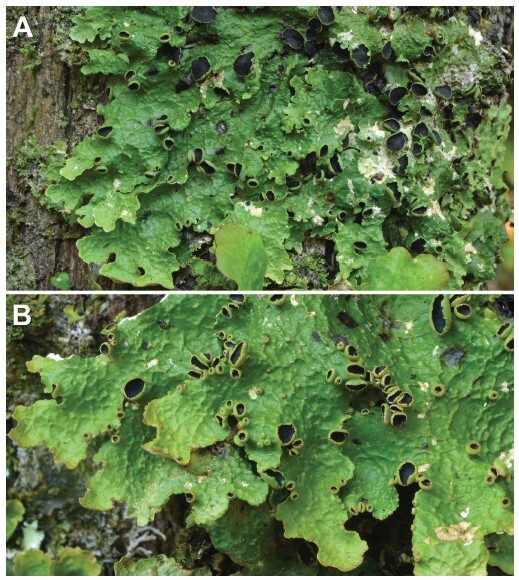
The Pseudocyphellaria hookeri clade (Peltigerales): a species pair-photosymbiodeme speciation complex?
1
Applied Molecular Solutions Research Group, School of Environmental
and Animal Sciences, Unitec, Private Bag 92025, Victoria
Street West, Auckland 1142, New Zealand
2
Botanischer Garten und Botanisches Museum Berlin, Freie Universität
Berlin, Königin-Luise-Straße 6–8, 14195 Berlin, Germany
3
Research Associate, Collections, Conservation and Research Division,
The Field Museum, 1400 South DuSable Lake Shore Drive, Chicago,
Illinois 60605, USA
4
Licenciatura en Biología, Universidad Distrital Francisco José de
Caldas, Cra. 4 No. 26B-54, Torre de Laboratorios, Herbario, Bogotá,
Colombia
5
Auckland War Memorial Museum Tāmaki Paenga Hira, Private Bag
92018, Victoria Street West, Auckland, New Zealand
6
Riverside Brookfield High School, 160 Ridgewood Rd, Riverside, IL
60546, USA
7
Current affiliation: LanzaTech Inc, Skokie, IL 60077, USA
Submission date: 2026-04-16
Acceptance date: 2026-07-06
Online publication date: 2026-07-31
Publication date: 2026-07-31
Plant and Fungal Systematics 2026; 71(1): 164-191
KEYWORDS
ABSTRACT
We present an integrative taxonomic revision of the Pseudocyphellaria hookeri
group in Aotearoa | New Zealand. Molecular data of the fungal ITS barcoding marker resolve
the group as monophyletic, in a strongly supported clade on a long stem branch, related
to the P. crocata group. Our study confirms the three species previously assigned to this
group, P. hookeri, P. durietzii, and P. montagnei, as part of this clade. In addition, a fourth
species was detected and is formally described here, namely P. coralloidea sp. nov. It is
characterized by a cyanobacterial photobiont and coralloid clusters of stout, robust isidia
partially eroding into soralia-like structures. Given that the P. hookeri clade contains four
different combinations of photobionts and reproductive structures (durietzii: green, apothecia;
montagnei: green, phyllidia; hookeri: cyanobacterial, apothecia; coralloidea: cyanobacterial:
isidia), we hypothesized that this clade evolved from a polymorphic ancestor representing
both a photosymbiodeme and a species pair. Indeed, both cases are well documented in
other taxa of Pseudocyphellaria. However, our results do not support such a conclusion,
but rather indicate step-wise transitions between photobionts and/or reproductive strategy.
We also found that P. durietzii and P. hookeri are not photomorphs sharing the same mycobiont,
as previously suggested. All four species of the P. hookeri group are described and
illustrated and their taxonomy is discussed, including a dichotomous key. We also provide
information about their distribution, ecology, and conservation status. We introduce the
term “soredisidia” for reproductive structures that represent a transition between genuine
soralia and true isidia. This contribution is dedicated to our esteemed colleague, André
Aptroot, on the occasion of his 65th birthday.
FUNDING
Funding for field and laboratory work for this study was provided
by a grant from the National Science Foundation (NSF)
to The Field Museum: DEB-1354884 “Collaborative Research:
Evolution, Diversification, and Conservation of a Megadiverse
Flagship Lichen Genus” (PI H. Thorsten Lumbsch, CoPI RL).
The Field Museum’s Prince Fund supported the internship of HR
as part of this research project.
REFERENCES (79)
1.
Altermann, S., Leavitt, S. D. & Goward, T. 2016. Tidying up the genus Letharia: introducing L. lupina sp. nov. and a new circumscription for L. columbiana. The Lichenologist 48: 423–439. https://doi.org/10.1017/S00242....
2.
Armaleo, D. & Clerc, P. 1991. Lichen chimeras: DNA analysis suggests that one fungus forms two morphotypes. Experimental Mycology 15: 1–10. https://doi.org/10.1016/0147-5....
3.
Baloch, E. & Grube, M. 2006. Evolution and phylogenetic relationships within Porinaceae (Ostropomycetidae), focusing on foliicolous species. Mycological Research 110: 125–136. https://doi.org/10.1016/j.mycr....
4.
Bull, S., Nicol, A., Strogen, D., Kroeger, K. F. & Seebeck, H. S. 2019. Tectonic controls on Miocene sedimentation in the Southern Taranaki Basin and implications for New Zealand plate boundary deformation. Basin Research 31: 253–273. https://doi.org/10.1111/bre.12....
5.
Buschbom, J. & Mueller, G. M. 2006. Testing “species pair” hypotheses: evolutionary processes in the lichen-forming species complex Porpidia flavocoerulescens and Porpidia melinodes. Molecular Biology and Evolution 23: 574–586. https://doi.org/10.1093/molbev....
6.
Crespo, A. & Pérez-Ortega, S. 2009. Cryptic species and species pairs in lichens: a discussion on the relationship between molecular phylogenies and morphological characters. Anales del Jardín Botánico de Madrid 66: 71–81. https://doi.org/10.3989/ajbm.2....
7.
de Lange, P. J., Galloway, D. J., Blanchon, D. J., Knight, A., Rolfe, J. R., Crowcroft, G. M. & Hitchmough, R. 2012. Conservation Status of New Zealand Lichens. New Zealand Journal of Botany 50: 303–363. https://doi.org/10.1080/002882....
8.
de Lange, P. J., Blanchon, D., Knight, A., Elix, J., Lücking, R., Frogley, K., Harris, A., Cooper, J. & Rolfe, J. 2018. Conservation Status of New Zealand Indigenous Lichens and Lichenicolous Fungi, 2018. New Zealand Threat Classification Series 27. Department of Conservation, Wellington. Available at: https://www.doc.govt.nz/global....
9.
Drummond, A. J. & Rambaut, A. 2007. BEAST: Bayesian evolutionary analysis by sampling trees. BMC Evolutionary Biology 7: 214. https://doi.org/10.1186/1471-2....
10.
Du Rietz, G. E. 1924. Die Soredien und Isidien der Flechten. Svensk Botanisk Tidskrift 18: 371–396.
11.
Galloway, D. J. 1985. Flora of New Zealand Lichens. P.D. Hasselberg, Government Printer. Wellington.
12.
Galloway, D. J. 1986. Non-glabrous species of Pseudocyphellaria from southern South America. The Lichenologist 18: 105–168. https://doi.org/10.1017/S00242....
13.
Galloway, D. J. 1988. Studies in Pseudocyphellaria (lichens) I. The New Zealand species. Bulletin of the British Museum (Natural History) Botany Series 17: 1–267.
14.
Galloway, D. J. 1992. Studies in Pseudocyphellaria (lichens) III. The South American species. Bibliotheca Lichenologica 46: 1–275.
15.
Galloway, D. J. 1994. Studies in Pseudocyphellaria (Lichens) IV. Palaeotropical species (excluding Australia). Bulletin of the Natural History Museum (London), Botany Series 24: 115–159.
16.
Galloway, D. J. 2007. Flora of New Zealand Lichens. 2nd ed. Manaaki Whenua Press, Lincoln.
17.
Galloway, D. J. 2015. Contributions to a history of New Zealand lichenology 5*. James Murray (1923–1961). Phytotaxa 198: 1–67. https://doi.org/10.11646/phyto....
18.
Galloway, D. J. & Elix, J. A. 2013. Reinstatement of Crocodia Link (Lobariaceae, Ascomycota) for five species formerly included in Pseudocyphellaria Vain. Australasian Lichenology 72: 32–42.
19.
Galloway, D. J., James, P. W. & Wilkins, A. L. 1983. Further nomenclature and chemical notes on Pseudocyphellaria in New Zealand. The Lichenologist 15: 135–145. https://doi.org/10.1017/S00242....
20.
Gardes, M. & Bruns, T. D. 1993. ITS primers with enhanced specificity for basidiomycetes – application to the identification of mycorrhizae and rust. Molecular Ecology 2: 113–118. https://doi.org/10.1111/j.1365....
21.
Green, T. G. A., Büdel, B., Heber, U., Meyer, A., Zellner, H. & Lange, O. L. 1993. Differences in photosynthetic performance between cyanobacterial and green algal components of lichen photosymbiodemes measured in the field. New Phytologist 125: 723–731. https://doi.org/10.1111/j.1469....
22.
Grewe, F., Lagostina, E., Wu, H., Printzen, C. & Lumbsch, H. T. 2018. Population genomic analyses of RAD sequences resolves the phylogenetic relationship of the lichen-forming fungal species Usnea antarctica and Usnea aurantiacoatra. MycoKeys 43: 91–113. https://doi.org/10.3897/mycoke....
23.
Hall, T. A. 1999. BioEdit: a user-friendly biological sequence alignment editor and analysis program for Windows 95/98/NT. Nucleic Acids Symposium Series 41: 95–98.
24.
Hall, T. A. 2011. BioEdit: an important software for molecular biology. GERF Bulletin of Biosciences 2: 60–61.
25.
Henssen, A. & Jahns, H. M. 1973 („1974“). Lichenes – Eine Einführung in die Flechtenkunde. Thieme, Stuttgart.
26.
Henssen, A., Keuck, G., Renner, B. & Vobis, G. 1981. The lecanoralean centrum. In: Reynolds, D. R. (ed.), Ascomycete Systematics. The Luttrellian Concept. Springer-Verlag, New York, Heidelberg, Berlin, pp. 138–234.
27.
Honegger, R. 1978. The ascus apex in lichenized fungi I. The Lecanora-, Peltigera- and Teloschistes-types. The Lichenologist 10: 47–67. https://doi.org/10.1017/S00242....
28.
Honegger, R. 2009. Lichen-forming fungi and their photobionts. In: Deising, H. B. (ed.), Plant Relationships (The Mycota, Vol. 5). Springer, Berlin Heidelberg, pp. 307–333. https://doi.org/10.1007/978-3-....
29.
Katoh, K. & Standley, D. M. 2013. MAFFT multiple sequence alignment software version 7: improvements in performance and usability. Molecular Biology and Evolution 30: 772–780. https://doi.org/10.1093/molbev....
30.
Keuck, G. 1977. Ontogenetisch-systematische Studie über Erioderma. Bibliotheca Lichenologica 6: 1–175.
31.
Kraichak, E., Crespo, A., Divakar, P. K., Leavitt, S. D. & Lumbsch, H. T. 2017. A temporal banding approach for consistent taxonomic ranking above the species level. Scientific Reports 7(1): 2297. https://doi.org/10.1038/s41598....
32.
Kraichak, E., Huang, J. P., Nelsen, M. P., Leavitt, S. D. & Lumbsch, H. T. 2018. A revised classification of orders and families in the two major subclasses of Lecanoromycetes (Ascomycota) based on a temporal approach. Botanical Journal of the Linnean Society 188: 233–249. https://doi.org/10.1093/botlin....
33.
Kroken, S. & Taylor, J. W. 2001. A gene genealogical approach to recognize phylogenetic species boundaries in the lichenized fungus Letharia. Mycologia 93: 38–53. https://doi.org/10.1080/002755....
34.
Lagostina, E., Dal Grande, F., Andreev, M. & Printzen, C. 2018. The use of microsatellite markers for species delimitation in Antarctic Usnea subgenus Neuropogon. Mycologia 110: 1047–1057. https://doi.org/10.1080/002755....
35.
Letrouit-Galinou, M. A. 1971. Études sur le “Lobaria laetevirens” (Lght.) Zahlb. (discolichen, Stictacee). I. Le thalle, les apothecies, les asques. Le Botaniste 54: 189–234.
36.
Lücking, R. 2004. A revised key to foliicolous Porinaceae (Ascomycota: Trichotheliales). Bibliotheca Lichenologica 88: 409–426.
37.
Lücking, R. 2019. Stop the abuse of time! Strict temporal banding is not the future of rank-based classifications in fungi (including lichens) and other organisms. Critical Reviews in Plant Sciences 38: 199–253. https://doi.org/10.1080/073526....
38.
Lücking, R. & Vězda, A. 1998. Taxonomic studies in foliicolous species of the genus Porina (lichenized Ascomycotina: Trichotheliaceae). II. The Porina epiphylla group. Willdenowia 28: 181–225. https://doi.org/10.3372/wi.28.....
39.
Lücking, R., Hodkinson, B. P. & Leavitt, S. D. 2017a. The 2016 classification of lichenized fungi in the Ascomycota and Basidiomycota – Approaching one thousand genera. The Bryologist 119: 361–416. https://doi.org/10.1639/0007-2....
40.
Lücking, R., Moncada, B., McCune, B., Farkas, E. E., Goffinet, B., Parker, D., Chaves, J. L., Lőkös, L., Nelson, P. R., Spribille, T., Stenroos, S., Wheeler, T., Yanez-Ayabaca, A., Dillman, K., Gockman, O. T., Goward, T., Hollinger, J., Tripp, E. A., Villella, J., Álvaro-Alba, W. R., Arango, C. J., Cáceres, M. E. S., Coca, L. F., Printzen, C., Rodríguez, C., Scharnagl, K., Rozzi, R., Soto-Medina, E. & Yakovchenko, L. S. 2017b. Pseudocyphellaria crocata (Ascomycota: Lobariaceae) in the Americas reveals to be ten species, and none of them is Pseudocyphellaria crocata. The Bryologist 120: 441–500. https://doi.org/10.1639/0007-2....
41.
Lücking, R., Leavitt, S. D. & Hawksworth, D. L. 2021. Species in lichen-forming fungi: balancing between conceptual and practical considerations, and between phenotype and phylogenomics. Fungal Diversity 109: 99–154. https://doi.org/10.1007/s13225....
42.
Lücking, R., Moncada, B., Widhelm, T. J., Lumbsch, H. T., Blanchon, D. J. & de Lange, P. J. 2022. The Sticta filix-Sticta lacera conundrum (lichenized Ascomycota: Peltigeraceae subfamily Lobarioideae): unresolved lineage sorting or developmental switch? Botanical Journal of the Linnean Society 199: 706–727. https://doi.org/10.1093/botlin....
43.
Lumbsch, H. T. & Leavitt, S. D. 2019. Introduction of subfamily names for four clades in Cladoniaceae and Peltigeraceae (Lecanoromycetes). Mycotaxon 134: 271–273. https://doi.org/10.5248/134.27....
44.
Mason, B. M., Mesaglio, T., Barratt Heitmann, J., Chandler, M., Chowdhury, S., Gorta, S. B. Z., Grattarola, F., Groom, Q., Hitchcock, C., Hoskins, L. & Lowe, S. K. 2025. iNaturalist accelerates biodiversity research. BioScience 75: 953–965. https://doi.org/10.1093/biosci....
45.
Mattsson, J. E. & Lumbsch, H. T. 1989. The use of the species pair concept in lichen taxonomy. Taxon 38: 238–241. https://doi.org/10.2307/122084....
46.
McCune, B., Rosentreter, R, Spribille, T., Breuss, O., & Wheeler, T. 2014. Montana Lichens: An Annotated List. Northwest Lichenologists, Corvallis, Oregon.
47.
Messuti, M. I., Passo, A., Scervino, J. M. & Vidal-Russell, R. 2016. The species pair Pseudocyphellaria pilosella-piloselloides (lichenized Ascomycota: Lobariaceae) is a single species. The Lichenologist 48: 141–146. https://doi.org/10.1017/S00242....
48.
Miądlikowska, J., Kauff, F., Högnabba, F., Oliver, J. C., Molnár, K., Fraker, E., Gaya, E., Hafellner, J., Hofstetter, V., Gueidan, C., Kukwa, M., Lücking, R., Björk, C., Sipman, H. J. M., Burgaz, A. R., Thell, A., Passo, A., Myllys, L., Goward, T., Fernández-Brime, S., Hestmark, G., Lendemer, J., Lumbsch, H. T., Schmull, M., Schoch, C., Sérusiaux, E., Maddison, D. R., Arnold, A. E., Lutzoni, F. & Stenroos, S. 2014. A multigene phylogenetic synthesis for the class Lecanoromycetes (Ascomycota): 1307 fungi representing 1139 infrageneric taxa, 312 genera and 66 families. Molecular Phylogenetics and Evolution 79: 132–168. https://doi.org/10.1016/j.ympe....
49.
Moncada, B. & Lücking, R. 2027. Lichens of the World. Princeton University Press, Princeton, Oxford.
50.
Moncada, B., Lücking, R. & Betancourt-Macuase, L. 2013a. Phylogeny of the Lobariaceae (lichenized Ascomycota: Peltigerales), with a reappraisal of the genus Lobariella. The Lichenologist 45: 203–263. https://doi.org/10.1017/S00242....
51.
Moncada, B., Coca, L. F. & Lücking, R. 2013b. Neotropical members of Sticta (lichenized Ascomycota: Lobariaceae) forming photosymbiodemes, with the description of seven new species. The Bryologist 116: 169–200. https://doi.org/10.1639/0007-2....
52.
Moncada, B., Reidy, B. & Lücking, R. 2014. A phylogenetic revision of Hawaiian Pseudocyphellaria sensu lato (lichenized Ascomycota: Lobariaceae) reveals eight new species and a high degree of inferred endemism. The Bryologist 117: 119–160. https://doi.org/10.1639/0007-2....
53.
Moncada, B., Lücking, R. & Lumbsch, H. T. 2020. Rewriting the evolutionary history of the lichen genus Sticta (Ascomycota: Peltigeraceae subfam. Lobarioideae) in the Hawaiian islands. Plant and Fungal Systematics 6: 95–119. https://doi.org/10.35535/pfsys....
54.
Moncada, B., Smith, C. W. & Lücking, R. 2021. A taxonomic reassessment of the genus Sticta (lichenized Ascomycota: Peltigeraceae) in the Hawaiian archipelago. The Lichenologist 53: 117–133. https://doi.org/10.1017/S00242....
55.
Morgulis, A., Coulouris, G., Raytselis, Y., Madden, T. L., Agarwala, R. & Schäffer, A. A. 2008. Database indexing for production MegaBLAST searches. Bioinformatics 24: 1757–1764. https://doi.org/10.1093/bioinf....
56.
Myllys, L., Lohtander, K. & Tehler, A. 2001. β-tubulin, ITS and group I intron sequences challenge the species pair concept in Physcia aipolia and P. caesia. Mycologia 93: 335–343. https://doi.org/10.1080/002755....
57.
Orange, A., James, P. W. & White, F. J. 2010. Microchemical Methods for the Identification of Lichens. Second Edition. British Lichen Society, London.
58.
Ott, S. 1988. Photosymbiodemes and their development in Peltigera venosa. The Lichenologist 20: 361–368. https://doi.org/10.1017/S00242....
59.
Poelt, J. 1970. Das Konzept der Artenpaare bei den Flechten. Deutsche Botanische Gesellschaft, Neue Folge 4: 187–198.
60.
Ranatunga, D. & Hoare, B. 2026. Auckland Museum Botany Collection. Version 1.103. Auckland War Memorial Museum. Occurrence dataset https://doi.org/10.15468/mnjkv... accessed via GBIF.org on 2026-06-29. https://gbif.org/occurrence/18....
61.
Ranft, H., Moncada, B., de Lange, P. J., Lumbsch, H. T. & Lücking, R. 2018. The Sticta filix morphodeme (Ascomycota: Lobariaceae) in New Zealand with the newly recognized species S. dendroides and S. menziesii: indicators of forest health in a threatened island biota? The Lichenologist 50: 185–210. https://doi.org/10.1017/S00242....
62.
Renner, B. & Galloway, D. J. 1982. Phycosymbiodemes in Pseudocyphellaria in New Zealand. Mycotaxon 16: 197–231.
63.
Rolfe, J., Hitchmough, R., Michel, P., Makan, T., Cooper, J. A., de Lange, P. J., Townsend, A. J., Miskelly, C. M. & Molloy, J. 2022. New Zealand Threat Classification System Manual 2022. Part 1: Assessments. Department of Conservation, Wellington, 45 pp. Available at: https://www.doc.govt.nz/global....
64.
Sanders, W. B. 2001. Composite lichen thalli of Sticta sp. from Brazil, with morphologically similar lobes containing either a chlorobiont or a cyanobiont layer. Symbiosis 31: 47–55.
65.
Simon, A., Lücking, R., Moncada, B., Mercado-Díaz, J. A., Bungartz, F., Cáceres, M. E. S., Gumboski, E. L., de Azevedo Martins, S. M., Spielmann, A., Parker, D. & Goffinet, B. 2020. Emmanuelia, a new genus of lobarioid lichen-forming fungi (Ascomycota: Peltigerales): phylogeny and synopsis of accepted species. Plant and Fungal Systematics 65: 76–94. https://doi.org/10.35535/pfsys....
66.
Spribille, T. & Muggia, L. 2013. Expanded taxon sampling disentangles evolutionary relationships and reveals a new family in Peltigerales (Lecanoromycetidae, Ascomycota). Fungal Diversity 58: 171–184. https://doi.org/10.1007/s13225....
67.
Stamatakis, A. 2014. RAxML version 8: a tool for phylogenetic analysis and post-analysis of large phylogenies. Bioinformatics 30: 1312–1313. https://doi.org/10.1093/bioinf....
68.
Tehler, A. 1982. The species pair concept in lichenology. Taxon 31: 708–714. https://doi.org/10.2307/121968....
69.
Thiers, B. 2008. Index Herbariorum: A global directory of public herbaria and associated staff. New York Botanical Garden. Available at: https://sweetgum.nybg.org/scie... [accessed 10 Mar. 2026].
70.
Torres, J. M., Barbosa, T. D., Kitaura, M. J., Spielmann, A. A. & Lorenz, A. P. 2021. Two new species of Sticta (Peltigeraceae subfam. Lobarioideae) from the Brazilian Cerrado (Brazilian savanna). The Bryologist 124: 506–521. https://doi.org/10.1639/0007-2....
71.
Trewick, S. A. & Bland, K. J. 2012. Fire and slice: palaeogeography for biogeography at New Zealand’s North Island/South Island juncture. Journal of the Royal Society of New Zealand 42: 153–183. https://doi.org/10.1080/030367....
72.
Wallis, G. P. & Trewick, S. A. 2009. New Zealand phylogeography: evolution on a small continent. Molecular Ecology 18: 3548–3580. https://doi.org/10.1111/j.1365....
73.
Wang, H., Schlumbom, P., Frank, E., Vetrova, V., Holmes, G., Pfahringer, B., Lim, N. & Bifet, A. 2025. Automatic species identification from images for Aotearoa. Journal of the Royal Society of New Zealand 55: 2216–2232. https://doi.org/10.1080/030367....
74.
White, T. J., Bruns, T. D., Lee, S. & Taylor, J. 1990. Amplification and direct sequencing of fungal ribosomal RNA genes for phylogenetics. In: Innis, M. A., Gelfand, D. H., Sninsky, J. J. & White, T. J. (eds), PCR Protocols. Academic Press, San Diego, pp. 315–322.
75.
Widhelm, T. J., Grewe, F., Goffinet, B., Wedin, M., Goward, T., Coca, L. F., Distefano, I., Košuthová, A. & Lumbsch, H. T. 2021a. Phylogenomic reconstruction addressing the Peltigeralean backbone (Lecanoromycetes, Ascomycota). Fungal Diversity 110: 59–73. https://doi.org/10.1007/s13225....
76.
Widhelm, T. J., Grewe, F., Huang, J. P., Ramanauskas, K., Mason‐Gamer, R. & Lumbsch, H. T. 2021b. Using RADseq to understand the circum‐Antarctic distribution of a lichenized fungus, Pseudocyphellaria glabra. Journal of Biogeography 48: 78–90. https://doi.org/10.1111/jbi.13....
77.
Widhelm, T. J., Rao, A., Grewe, F. & Lumbsch, H. T. 2023. High-throughput sequencing confirms the boundary between traditionally considered species pairs in a group of lichenized fungi (Peltigeraceae, Pseudocyphellaria). Botanical Journal of the Linnean Society 201: 471–482. https://doi.org/10.1093/botlin....
78.
Wiklund, E. & Wedin, M. 2003. The phylogenetic relationships of the cyanobacterial lichens in the Lecanorales suborder Peltigerineae. Cladistics 19: 419–431. https://doi.org/10.1111/j.1096....
79.
Wilton, A. 2026. Allan Herbarium (CHR). Landcare Research. Occurrence dataset https://doi.org/10.15468/x5ucv... accessed via GBIF.org on 2026-06-29. https://gbif.org/occurrence/10....
Share
RELATED ARTICLE
| eISSN: | 2657-5000 |
| ISSN: | 2544-7459 |


We process personal data collected when visiting the website. The function of obtaining information about users and their behavior is carried out by voluntarily entered information in forms and saving cookies in end devices. Data, including cookies, are used to provide services, improve the user experience and to analyze the traffic in accordance with the Privacy policy. Data are also collected and processed by Google Analytics tool (more).
You can change cookies settings in your browser. Restricted use of cookies in the browser configuration may affect some functionalities of the website.
You can change cookies settings in your browser. Restricted use of cookies in the browser configuration may affect some functionalities of the website.